Katmai National Park: Volcanoes, Salmon, and the Brown Bears of Coastal Alaska
ParksDirectory.com™ | National Park Summary & History
A park larger than its famous waterfall
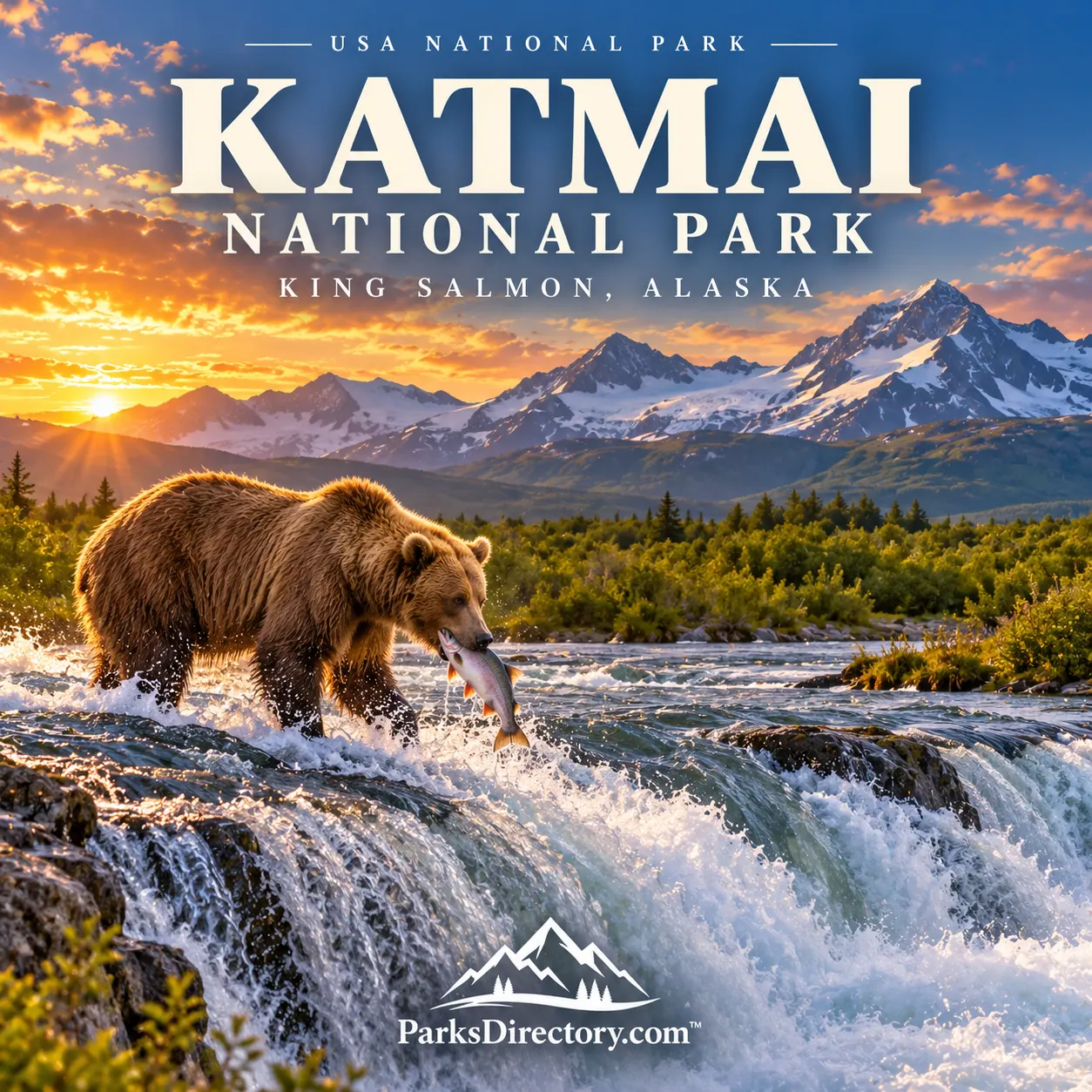
Katmai is widely recognized through images of brown bears fishing at Brooks Falls. That remarkable scene is genuine, but it represents one small part of a landscape extending across lakes, volcanic mountains, river systems, and the Alaska Peninsula coast. Katmai’s original protection focused on the aftermath of a catastrophic eruption. Its later significance expanded to include wildlife, watersheds, and a long record of human adaptation.[1]
The park and adjoining preserve lie in southwestern Alaska on the Alaska Peninsula. King Salmon serves as an administrative and transportation gateway outside the main protected landscape. The national park occupies approximately 3.67 million acres and the preserve about 419,000 acres. Together they cover roughly 4.09 million acres, or 6,395 square miles. Those combined figures should not be presented as the national park alone.[2][3]
President Woodrow Wilson established Katmai National Monument on September 24, 1918. The Alaska National Interest Lands Conservation Act enlarged and redesignated the area as Katmai National Park and Preserve on December 2, 1980. The two dates connect an early volcanic monument with the much broader landscape protected today.[2:1]
The eruption that transformed the region
In 1912, an enormous eruption at Novarupta changed the surrounding country. Ash and hot volcanic deposits buried valleys, and Mount Katmai’s summit collapsed to form a caldera. Although the park carries Katmai’s name, Novarupta was the principal eruptive vent. Distinguishing the two avoids one of the most common misunderstandings about this event, which was the largest volcanic eruption of the twentieth century.[4]
The devastation had consequences far beyond the immediate vent. The eruption transformed drainage systems and habitats and disrupted communities. Subsequent scientific investigations revealed an extraordinary landscape of cooling deposits and escaping steam. Robert Griggs and his expedition described the Valley of Ten Thousand Smokes, a name reflecting the many fumaroles that once rose from its surface.[4:1][5]
From volcanic spectacle to protected landscape
Griggs and other advocates helped bring national attention to the eruption’s aftermath. The 1918 monument protected a place of exceptional scientific and scenic interest. Its purpose was not originally centered on providing a bear-viewing destination. That difference is important when tracing the park’s history: the feature that first justified protection and the experience most familiar to modern audiences are not the same.[5:1]
Over the following decades, expansions brought additional land and resources within the monument. The 1980 legislation established the national park and preserve framework, recognizing a connected landscape with diverse natural and cultural values. Lakes, salmon habitat, coastal resources, and wilderness became central to the area’s conservation story alongside active volcanism.[5:2][6]
A human landscape spanning millennia
Katmai protects approximately 9,000 years of human history. Archaeological evidence and living community connections reveal people adapting to changing climates, coastlines, and food resources. The eruption did not strike an empty landscape. Villages and established patterns of life were affected, and descendants of the region’s earlier inhabitants retain connections to places now contained within the park.[1:1][5:3]
Later histories include Russian and American influence, commercial fishing, trapping, and other enterprises. These activities tied the Alaska Peninsula to wider economic networks while local people continued to depend on regional resources. A useful historical perspective therefore places the national-park boundary within a much longer story rather than treating 1918 or 1980 as the beginning of human involvement.[5:4]
Why the bears gather
Katmai’s celebrated brown bears benefit from highly productive feeding opportunities. At Brooks River, returning salmon concentrate food in a place where bears can use several fishing techniques. Some wait at the falls for leaping fish; others work in pools or shallower water. Watching these differences reveals individual behavior and competition rather than a single routine repeated by every animal.[7]
Coastal bears use additional resources, including sedge meadows and intertidal foods. They are part of the same species as interior grizzlies, although abundant coastal foods can support larger body sizes. The park should not be described as an island population of Kodiak bears: Kodiak Island is a different place. Katmai’s bear story is inseparable from its varied habitats and seasonal food supplies.[8]
Salmon also connect the sea with inland ecosystems. After growing in the ocean, fish return nutrients to rivers, lakes, predators, and surrounding soils. Bears carry and leave fish remains along shorelines, extending that transfer beyond the water itself. The famous waterfall is thus one visible point in a much larger ecological exchange linking Bristol Bay watersheds and marine life.[9]
The Valley of Ten Thousand Smokes today
The valley remains one of Katmai’s most notable features, but visitors should not expect the dense forest of steaming vents seen by early explorers. Much of the deposited material has cooled, and rivers have cut into the volcanic fill. Broad surfaces of ash and pumice, deep erosional channels, and surrounding peaks now convey both the scale of the eruption and the processes reshaping its aftermath.[4:2]
The landscape also played an unexpected role in space exploration. In 1965 and 1966, Apollo astronauts trained in the valley, practicing geological observation and communication in unfamiliar volcanic terrain. That episode links Katmai’s scientific importance with the history of lunar exploration. The valley was useful not because it was literally identical to the Moon, but because it challenged observers to describe and interpret an extraordinary geological setting.[10]
Lakes, coast, and the wider Katmai experience
Brooks Camp offers the best-known introduction, yet the Naknek Lake system and the coast reveal the park’s greater scale. Lakes and rivers support fish and wildlife, while coastal meadows lie beneath glacier-covered volcanic mountains. These settings differ sharply from the relatively barren eruption deposits. Their juxtaposition is one of Katmai’s defining qualities: productive ecosystems and evidence of immense disturbance exist within the same protected region.[1:2][6:1]
Katmai matters because it allows those processes to be studied together. Its bears are compelling, its volcanic history is dramatic, and its human record is deep. The most rewarding understanding of the park comes from connecting them—seeing a salmon-fed bear, a recovering volcanic valley, and an ancient cultural landscape as parts of one dynamic Alaska Peninsula environment.[6:2][9:1]
Sources
Research reviewed September 6, 2026. Park and preserve sizes are rounded from NPS acreage reporting; the combined overview is approximately 4.09 million acres. The older breakdown is supplied for scope, not represented as a new cadastral survey. Wildlife sightings and volcanic conditions vary.
National Park Service, Katmai park overview. https://www.nps.gov/katm/ ↩︎ ↩︎ ↩︎
National Park Service, “NPS Geodiversity Atlas—Katmai National Park & Preserve, Alaska.” https://www.nps.gov/articles/nps-geodiversity-atlas-katmai-national-park-alaska.htm ↩︎ ↩︎
National Park Service, Land Resources Division, Listing of Acreage, December 31, 2016, page 8, park/preserve breakdown. https://irma.nps.gov/Stats/FileDownload/1297 ↩︎
National Park Service, “Valley of Ten Thousand Smokes and the 1912 Novarupta Eruption.” https://www.nps.gov/katm/learn/nature/valley-of-ten-thousand-smokes.htm ↩︎ ↩︎ ↩︎
National Park Service, “History.” https://www.nps.gov/katm/learn/historyculture/history.htm ↩︎ ↩︎ ↩︎ ↩︎ ↩︎
National Park Service, Katmai Foundation Statement, purpose and significance. https://parkplanning.nps.gov/showFile.cfm?projectID=25363&sfid=58222 ↩︎ ↩︎ ↩︎
National Park Service, “Bears of Katmai.” https://www.nps.gov/katm/learn/nature/bears-of-katmai.htm ↩︎
National Park Service, “Coastal Brown Bears.” https://www.nps.gov/katm/learn/nature/coastal-brown-bears.htm ↩︎
National Park Service, “Swimming the Brooks River.” https://www.nps.gov/katm/blogs/swimming-the-brooks-river.htm ↩︎ ↩︎
National Park Service, “Following in the Footsteps of Astronauts.” https://www.nps.gov/katm/blogs/following-in-the-footsteps-of-astronauts.htm ↩︎