USA Dog Parks: Off-Leash History, Everyday Popularity, and Community Value
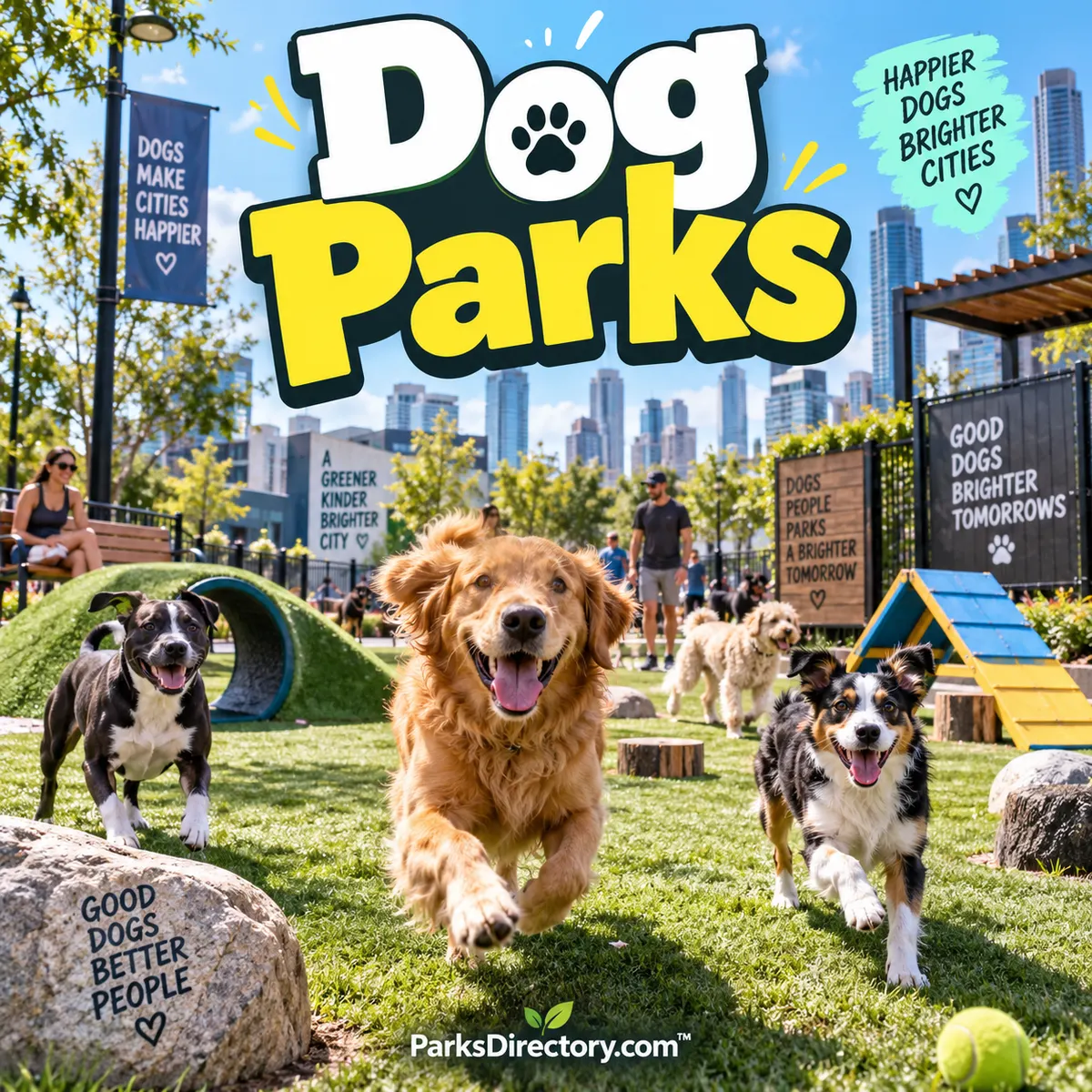
A good dog park is more than a fenced space with a convenient gate. It is a shared arrangement among dog owners, other residents, and the people responsible for public land. When that arrangement works, dogs have an appropriate place to move, owners develop familiar routines, and a neighborhood gains another reason for people to spend time outdoors together.
For readers researching USA dog parks on ParksDirectory™, the most important question is not simply where the nearest off-leash area lies. It is whether that setting suits the particular dog, the time of day, and the purpose of the visit. A quiet walk, a private exercise session, and a busy group-play area meet different needs.
How dog parks became an American institution
Dogs lived alongside Americans long before municipalities created dedicated places for off-leash recreation. The modern dog park developed as communities negotiated the competing demands of pets, pedestrian safety, shared green space, and leash rules. Its history is therefore a story of urban planning and neighborhood advocacy as much as animal companionship.
Berkeley, California, is central to that story. Smithsonian’s history identifies the off-leash area created at Ohlone Park in 1979 as a foundational municipal example, associated with local advocates including Doris Richards. It is widely credited as the first official municipal dog park in the United States. That carefully qualified description is more defensible than claiming nobody had ever previously set aside space for dogs.[1]
The City of Berkeley still identifies an off-leash dog area within Ohlone Park. The continuing presence of that facility illustrates how an idea initially associated with neighborhood advocacy became part of ordinary park infrastructure. Dog owners were no longer asking only for exceptions to general rules; they were helping establish a recognized recreational use with a designated location.[2]
The broader implication is important. Creating an authorized place for an activity can reduce conflict elsewhere, but designation alone does not solve everything. The site still needs suitable design, maintenance, clear expectations, and cooperation from users. A dog park’s history is incomplete without the ongoing work required after the fence is installed.
Popularity in the past and present
The expansion of dog parks can be measured without pretending that one database captures the whole country. In 2019, the Trust for Public Land reported 810 off-leash dog parks in the 100 largest U.S. cities, a 74 percent increase since 2009. Those figures describe a particular historical urban sample, not the current total of every dog park in America.[3]
The contemporary household context is also substantial. The American Pet Products Association reported that 71 million U.S. households owned dogs in 2025. Its wider industry report placed total American pet spending at $158 billion that year. The spending figure includes many animals and product categories; it is not dog park revenue and cannot be used as a direct estimate of dog parks’ economic impact.[4]
Together, the historical growth in urban facilities and the large dog-owning population help explain why off-leash access remains a recurring community issue. They do not prove that every neighborhood needs the same design or that every dog benefits from the same experience. Local demand depends on housing patterns, available alternatives, travel distance, and the behavior of the people using the space.
A useful measure of popularity is therefore repeat usefulness. Does a park remain pleasant during busy periods? Can a newcomer understand its rules? Do owners feel comfortable leaving when the group dynamic is unsuitable? A facility that produces frequent, manageable visits may serve its community better than one that attracts large crowds but repeated conflict.
Understanding different types of dog parks
“Dog park” can describe several arrangements: a fenced municipal area, a larger designated off-leash landscape, or a privately operated exercise facility. Those models should not be treated as interchangeable. A fence is not a promise of supervision, and a public recreation site does not necessarily provide staff to monitor every interaction.
Official city directories can clarify where off-leash use is authorized. Los Angeles, for example, maintains a dog park directory separate from general park listings. That distinction is useful anywhere: a green space allowing leashed dogs is not automatically an off-leash dog park. Confirm the specific location and its posted conditions instead of relying on an informal map label.[5]
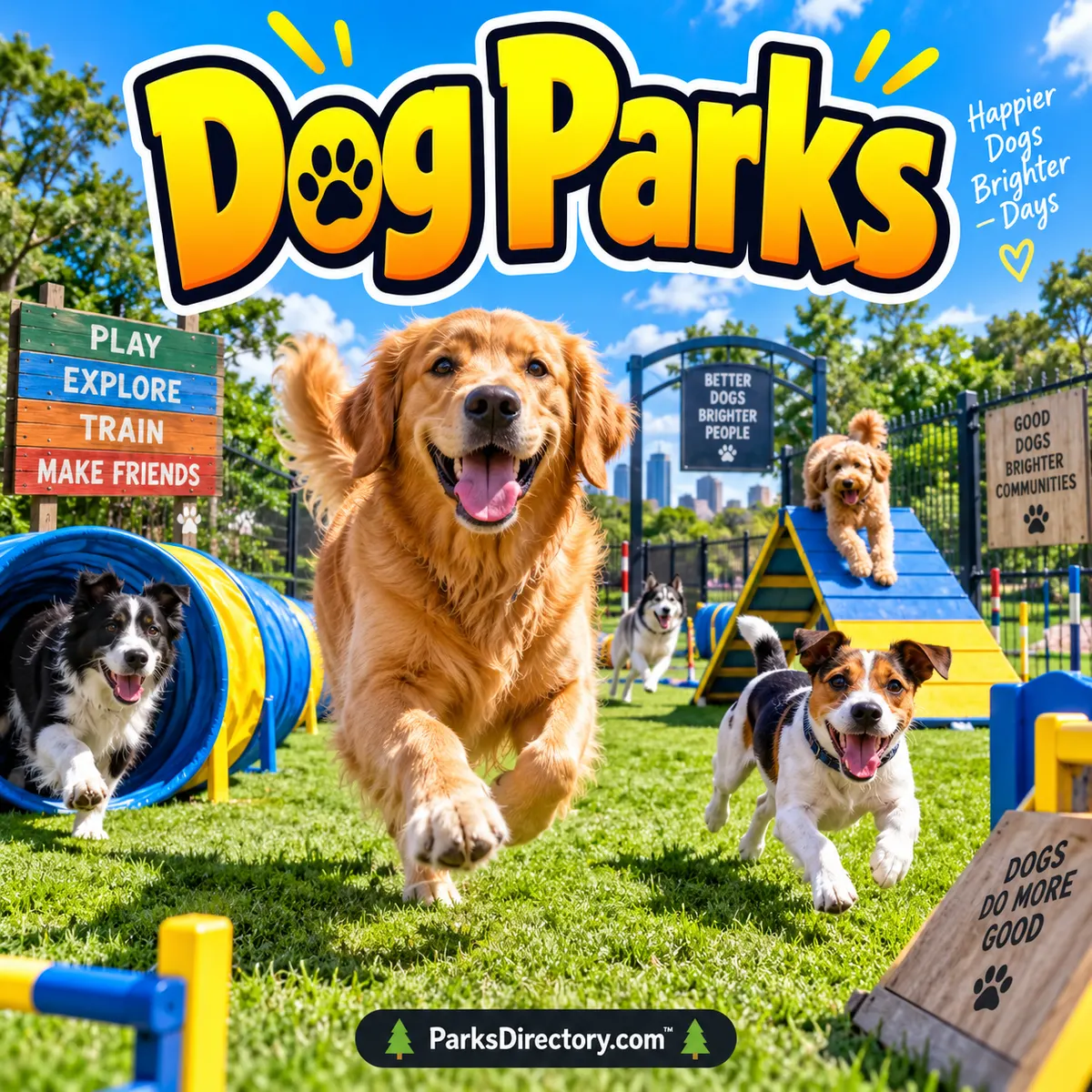
When comparing fenced dog parks, examine the practical layout. A secure entrance, enough space to move away from other dogs, and appropriate separation areas may matter more than decorative features. Check shade, seating, waste stations, water availability, and the condition of the ground. Also consider whether the walk from the parking area is manageable for the owner and dog.
A smaller neighborhood site may be convenient for a brief visit, while a larger destination may offer more room but require more travel and closer attention to navigation. Choose on the basis of the actual outing. There is no universal rule that the largest or busiest park will provide the best experience.
Matching the visit to the dog
Veterinary guidance is especially important for group settings. The American Veterinary Medical Association recommends vaccination and parasite control as foundations for reducing disease risks where dogs socialize. Discuss the dog’s age, health, and circumstances with a veterinarian rather than assuming that a general online checklist establishes readiness for every animal.[6]
Behavior matters too. Veterinary guidance advises caution about taking fearful or aggressive dogs into dog parks. A busy off-leash area is not a substitute for an individualized behavior plan, and leaving early is a sensible decision when a dog is uncomfortable. Owners should remain attentive instead of treating the visit as unsupervised daycare.[7]
For a practical first visit, observe before entering. Notice crowd density, the pace of play, and whether owners are monitoring their dogs. Keep the entrance clear and follow the facility’s instructions about leashes and gates. When the setting does not look suitable, choosing another time or a different activity is a successful adjustment, not a failed outing.
Avoid making other users responsible for managing a preventable problem. Bring what is needed for cleanup, remain close enough to respond, and do not insist that another dog or owner participate in an interaction. A welcoming atmosphere depends on the ability to create distance and end an encounter without an argument.
The economic impact of dog parks in the USA
Dog parks create economic connections, but the evidence should be kept in proportion. Construction and ongoing care can support fencing contractors, landscape workers, drainage specialists, and maintenance crews. Nearby businesses may benefit when owners combine a visit with shopping or a meal. Those are plausible local pathways, not proof of a fixed nationwide financial return.
The strongest public investment case starts with a realistic operating budget. Waste removal, replacement bags, gate repairs, surface management, and water infrastructure can remain recurring obligations long after opening. Ignoring those costs can turn an attractive proposal into an undermaintained facility. A parks department should know who is responsible, how problems are reported, and what level of care is funded.
Benefits are also broader than sales. An accessible off-leash area may provide useful recreation for residents without private outdoor space. It can create an opportunity for neighbors to meet without a purchase requirement. Those services deserve consideration even when they do not generate direct income for the operator or fit neatly into a commercial return calculation.
At the same time, other residents’ interests belong in the assessment. Noise, parking pressure, location near homes, and the allocation of limited parkland can affect the surrounding neighborhood. Good planning acknowledges those tradeoffs openly. Describing a dog park as universally beneficial without asking who bears costs is less persuasive than explaining how a particular site will be managed responsibly.
Designing for shared public space
A dog park works best as part of a wider park system, not as permission to ignore rules outside its boundary. Owners should respect nearby athletic fields, playgrounds, trails, and wildlife areas. The designated space is valuable partly because it makes different uses easier to distinguish. Clear transitions between leashed and off-leash areas help reduce confusion.
Information can be as important as physical design. Visible rules, a maintenance contact, and accurate operating notices make the facility easier to use. A visitor should not have to guess whether a closure applies, whether an entrance is functioning, or how to report a damaged fence. Straightforward communication benefits regulars and travelers alike.
Volunteer involvement can be useful, but it should complement rather than obscure operator responsibility. Organizing a cleanup or welcoming new users is different from being accountable for structural repairs or enforcement. Clear roles help preserve goodwill and make it less likely that a few committed residents become responsible for an unfunded public service.
The future of American dog parks
The next phase should emphasize suitability and care rather than simply adding fenced acreage. Communities may find value in quieter spaces, better entry design, more informative signs, and sites that serve neighborhoods currently lacking convenient options. Evaluating actual use can reveal whether a facility needs more room, different maintenance, or a revised layout rather than another decorative amenity.
Future success will also depend on treating dog parks as one option among several. Some dogs and owners will prefer a leashed trail or controlled exercise elsewhere. A good directory should help people make that distinction instead of implying that off-leash group play is the goal for every pet. The most responsible recommendation is the one that fits the individual visit.
Use ParksDirectory™ to begin identifying possibilities, then confirm access and rules with the operator and health questions with a veterinarian. America’s dog parks grew from the practical needs of people sharing limited space. Their best future follows the same principle: useful recreation for dogs and owners, balanced with thoughtful care for the entire community.
Sources
Smithsonian Magazine, “How Dog Parks Took Over the Urban Landscape.” https://www.smithsonianmag.com/history/how-dog-parks-took-over-urban-landscape-180973902/ ↩︎
City of Berkeley, “Ohlone Park.” https://berkeleyca.gov/community-recreation/parks-recreation/parks/ohlone-park ↩︎
Trust for Public Land, 2019 city rankings of dog parks, covering the 100 largest U.S. cities. https://www.tpl.org/media-room/trust-public-land-releases-us-city-rankings-dog-parks ↩︎
American Pet Products Association, “U.S. Pet Industry Reaches $158 Billion in 2025,” released in 2026. https://americanpetproducts.org/news/u.s.-pet-industry-reaches-158-billion-in-2025-poised-for-continued-growth-in-2026 ↩︎
Los Angeles Department of Recreation and Parks, “Dog Parks.” https://recreation.parks.lacity.gov/dogparks ↩︎
American Veterinary Medical Association, “Disease Risks for Dogs in Canine Social Settings.” https://www.avma.org/resources-tools/pet-owners/petcare/disease-risks-dogs-social-settings ↩︎
American Veterinary Medical Association, “Advising Clients About Dog Parks.” https://www.avma.org/javma-news/2006-09-15/advising-clients-about-dog-parks ↩︎