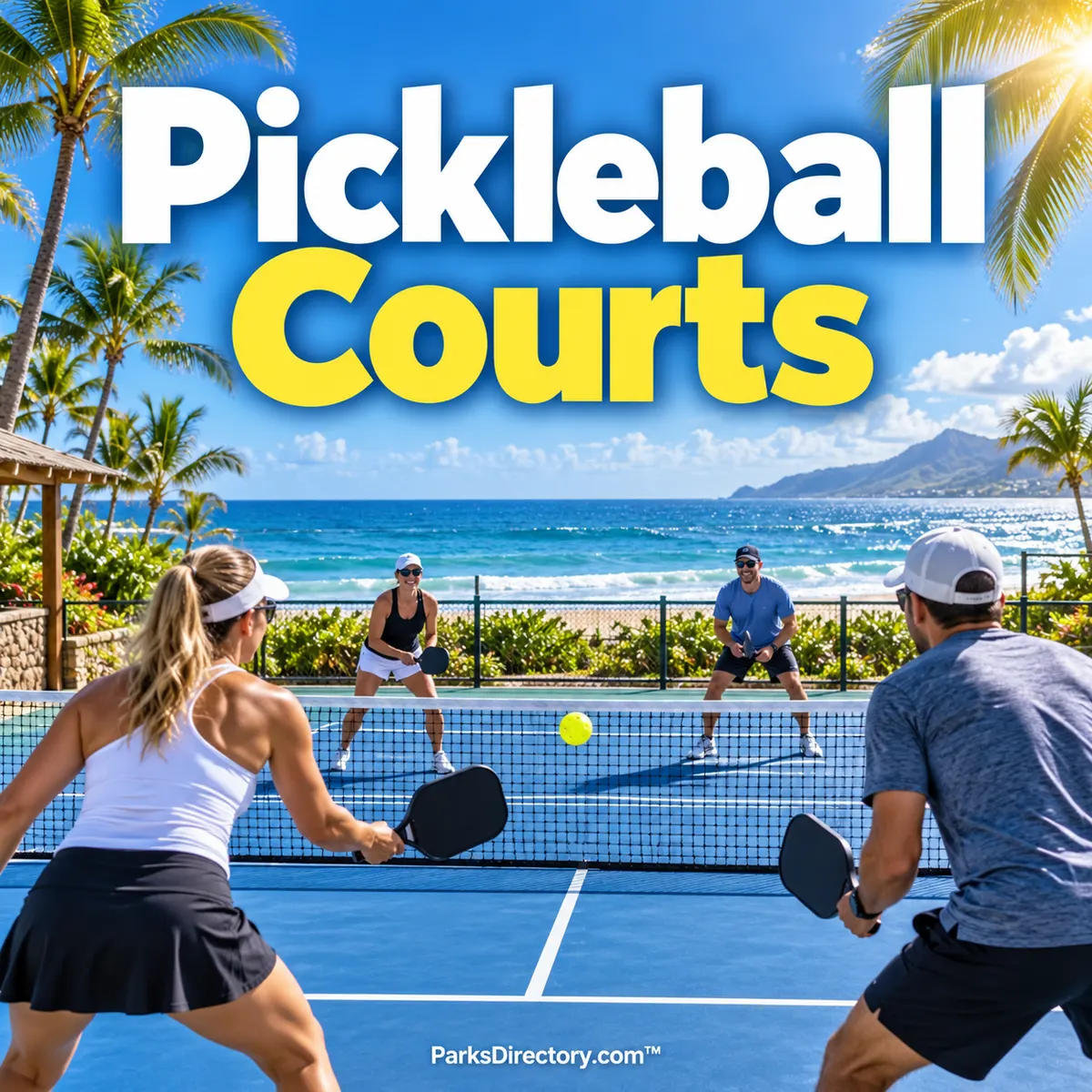
USA Pickleball Courts: History, Explosive Growth, and the Future of Community Play
A pickleball court can turn a spare hour into a regular social appointment. Four players, a net, a few paddles, and a perforated ball are enough to create an absorbing contest. For communities, however, the court represents more than a compact playing surface. It raises questions about recreation access, scheduling, neighborhood compatibility, and how to maintain public facilities when demand grows faster than expected.
Searching for USA pickleball courts is therefore about finding the right playing environment, not simply the nearest painted rectangle. ParksDirectory™ provides a starting point for that exploration. The most useful next step is to confirm who operates a facility, when newcomers can play, and whether its reservations, fees, and skill expectations fit the experience you actually want.
How pickleball began in the United States
Pickleball originated on Bainbridge Island, Washington, in the summer of 1965. USA Pickleball credits Joel Pritchard, Bill Bell, and Barney McCallum with developing the game. Its beginnings were recreational and improvised rather than the result of a professional league’s expansion plan. The founders adapted available equipment and worked toward a game that family members could enjoy together.[1]
That origin remains important because it helps explain the sport’s social character. Pickleball did not require newcomers to join an established professional tradition before participating. Its early appeal lay in creating an enjoyable activity with manageable equipment and space. Today’s beginner sessions are strongest when they retain that spirit instead of making the first visit feel like an examination.
The naming story is often repeated inaccurately. USA Pickleball’s historical account attributes the name to Joan Pritchard and a reference to rowing’s “pickle boat,” rather than to the family’s dog. Whatever version a visitor has previously heard, the more significant historical point is that a backyard invention became a recognizable sport through shared rules, equipment development, and people teaching one another.[1:1]
From a niche pastime to millions of American players
Recent participation research shows how far the sport has moved beyond its modest beginnings. The Sports & Fitness Industry Association reported that 24.3 million Americans played pickleball in 2025, compared with 4.2 million in 2020. These are participation estimates, not a count of league members or people playing every week. Nevertheless, the change demonstrates substantial growth within a short period.[2]
The same research counted 7.5 million core players in 2025, defining that group as people playing at least eight times during the year. The comparable figure for 2020 was 1.4 million. This distinction matters: occasional participation shows reach, while repeated play offers stronger evidence of continuing demand for court time, instruction, and organized activities.[2:1]
Popularity does not guarantee that every proposed facility will succeed. A national growth figure cannot reveal whether a particular neighborhood needs additional evening courts, affordable beginner lessons, or better management of existing space. Local decisions should use local observations: waiting times, reservation patterns, community surveys, and the number of people who return after introductory sessions.
Understanding public, shared, and indoor pickleball courts
Public pickleball courts may offer open access, scheduled sessions, reservations, or some combination. Shared facilities can accommodate different sports at different times, while dedicated courts remove some of the confusion caused by overlapping lines and temporary nets. Indoor pickleball courts provide another option, especially when weather makes outdoor scheduling unreliable. These categories describe different experiences rather than a simple hierarchy of quality.
USA Pickleball’s 2025 Annual Growth Report, updated in January 2026, reported 18,258 locations and 82,613 known courts in the Pickleheads database. A location can contain several courts, and a database entry does not automatically mean a newly constructed, free, publicly owned facility. Travelers should check the individual listing’s access conditions rather than treating the national inventory as a uniform public network.[3]
When comparing facilities, look beyond the court photograph. Ask whether nets are permanent, how much space surrounds the playing area, whether seating and shade are available, and how users enter without interrupting a rally. Someone searching for pickleball courts near me may benefit more from a welcoming scheduled session slightly farther away than from a crowded court around the corner.
Learning the game without feeling out of place
Pickleball uses solid paddles and a perforated ball, and its standard court measures 20 by 44 feet. The non-volley zone near the net is central to the game’s tactics: players must understand when they may strike a ball before it bounces. Official rules also distinguish legal serves, scoring procedures, and the opening bounce requirements. Learn from the current rulebook rather than relying on an argument during play.[4]
For a first outing, borrow equipment or attend an introductory clinic before choosing expensive gear. Tell other players that you are new, ask how the facility rotates waiting participants, and agree on the format before starting. Beginner-friendly play should make it possible to learn positioning and scoring without constant interruption or embarrassment.
A good session also respects the people on neighboring courts. Wait for an appropriate break before crossing, call attention to an escaped ball rather than chasing it into active play, and avoid occupying a court beyond the posted limit. These habits are simple, but they determine whether a busy recreation area feels cooperative or adversarial.
The economic impact of pickleball in the USA
Pickleball creates economic activity through court construction, resurfacing, equipment sales, instruction, leagues, and facility management. Destination tournaments can also bring customers to hotels, restaurants, and transportation providers. The essential distinction is between these separate revenue streams and a defensible national economic-impact total. A count of players cannot be converted into billions of dollars without assumptions about spending, geography, and substitution.
As one specific example, USA Pickleball reported an estimated $3.6 million economic impact from its 2024 National Championships in Mesa, Arizona. That is the organizer’s estimate for one event, not a national industry total or an independently established net public benefit. It illustrates the tourism potential of competition while leaving important questions about methodology and local costs open.[3:1]
For a private club, a sustainable business requires more than strong opening-week interest. Rent, staffing, insurance, utilities, cleaning, equipment replacement, and maintenance continue when courts are empty. Compare realistic bookings across the whole week, not just prime evening hours. A facility serving beginners, regular players, and lessons may distribute demand differently from one relying mainly on tournaments.
For a public operator, success has a different meaning. Affordable access and well-used recreation space can matter even when user fees do not cover every expense. The relevant evaluation should show who benefits, what other activities share the site, and how future repairs will be funded. A grant that builds courts without a maintenance plan can leave the next budget carrying an avoidable burden.
Noise, scheduling, and neighborhood trust
Sound is a genuine planning consideration, not evidence that players or neighbors are automatically unreasonable. USA Pickleball has introduced Quiet and Noise-Reduced equipment categories and supports acoustic research. Those developments recognize a practical challenge: the sport’s growth depends partly on making play compatible with the places where courts operate.[5]
Equipment choices alone should not be assumed to resolve every site issue. A responsible planning process considers the court’s location, surrounding buildings, operating hours, and professional acoustic advice where needed. Residents should be able to understand the proposal before construction, and players should know the rules before arriving. Addressing concerns early is usually a better approach than treating complaints as a public-relations problem later.
Scheduling deserves similar care when pickleball shares space with tennis, basketball, or other recreation. Count actual use, provide transparent time allocations, and offer a process for revisiting the arrangement. Converting a surface may create opportunities for one group while removing them from another. Good park management explains that tradeoff instead of presenting one sport’s popularity as the only relevant consideration.
Building a more inclusive playing community
A court is not fully accessible merely because anyone may theoretically enter. Cost, transport, registration systems, session timing, and confidence can all affect participation. Consider programs with loaner paddles, clear beginner sessions, and a straightforward explanation of how open play works. A posted rotation system can help a visitor arriving alone join the activity without needing an established social connection.
USA Pickleball Serves supports community access through initiatives involving equipment, instruction, and facility improvements. Its work offers one model for connecting the sport’s growth with opportunities beyond established clubs. Local organizers can apply the same principle by asking which groups are absent and what practical barriers prevent them from attending.[6]
Inclusion also means offering different kinds of enjoyment. Some players want demanding competition; others value exercise, conversation, or a gradual return to organized recreation. Separate session descriptions can prevent disappointment without declaring one group more legitimate. Judge a program by whether participants understand its purpose and feel able to return, not by whether every match resembles a televised event.
The future of American pickleball courts
The next stage should focus on durable participation rather than treating rapid growth as an endless guarantee. Communities need facilities that remain affordable, maintainable, and useful after the initial excitement settles. Private operators need repeat customers and realistic operating budgets. Both benefit when players can progress from their first lesson into a regular routine without encountering unnecessary financial or social obstacles.
Technology can help organize reservations, but it should not become the only doorway into public recreation. Preserve clear on-site information and workable alternatives for people who do not use an app. Pair any new construction with sensible lighting, appropriate sound planning, and long-term maintenance. Better management of existing courts may sometimes deliver more value than a larger inventory with confusing access.
The sport’s history began with people solving a simple problem: how to enjoy playing together. That remains a useful test for its future. Use ParksDirectory™ to begin researching pickleball courts, then verify the operator’s current details and choose a session suited to your ability and schedule. A successful first visit is not necessarily a victory on the scoreboard; it is finding a place where you look forward to playing again.
Sources
USA Pickleball, “The Origin of Pickleball and How Pickleball Got Its Name,” historical account. https://usapickleball.org/pickleball-stories/how-pickleball-got-its-name/ ↩︎ ↩︎
Sports & Fitness Industry Association, “SFIA Releases 2026 Pickleball Single Sport Report; Team Sports Reports to Follow,” June 4, 2026; 2025 participation estimates. https://sfia.org/resources/sfia-releases-2026-pickleball-single-sport-report-team-sports-reports-to-follow/ ↩︎ ↩︎
USA Pickleball, “Annual Growth Reports,” updated January 30, 2026; 2025 court inventory and separately labeled 2024 championship economic-impact estimate. https://usapickleball.org/about/annual-growth-report/ ↩︎ ↩︎
USA Pickleball, official rules and rulebook resources. https://usapickleball.org/rules/ ↩︎
USA Pickleball, “Pickleball Acoustics and Noise Mitigation.” https://usapickleball.org/acoustics/ ↩︎
USA Pickleball Serves, community-access programs. https://usapickleball.org/serves/ ↩︎