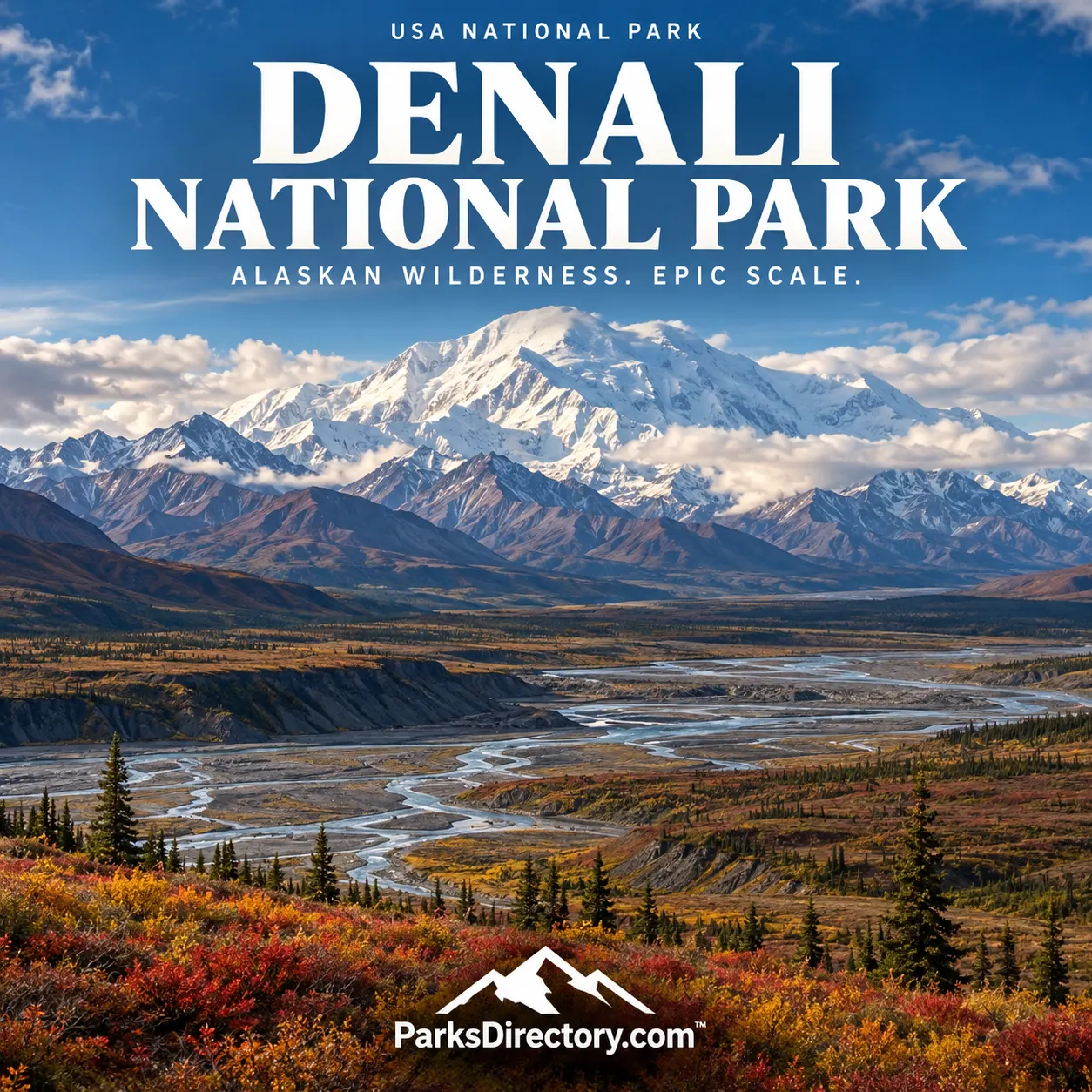
Denali National Park

Denali Park, Alaska · Alaska outdoor places

Denali National Park

History

Denali National Park: Wildlife Conservation and the Great Landscapes of the Alaska Range

ParksDirectory.com™ | National Park Summary & History

Location, size, and two important establishment dates

Denali National Park and Preserve lies in Interior Alaska, spanning a broad section of the Alaska Range and its northern and southern landscapes. The National Park Service reports a combined area of approximately 6,075,030 acres, or 9,492 square miles. That total includes roughly 4.74 million acres of national park and 1.33 million acres of national preserve. These are distinct designations; the combined acreage should not be presented as the national-park component alone.[1]

The original Mount McKinley National Park was established on February 26, 1917. On December 2, 1980, the Alaska National Interest Lands Conservation Act expanded the protected area and established the modern Denali National Park and Preserve framework. The larger unit is famous for North America’s highest summit, a 20,310-foot mountain commonly known as Denali and identified as Mount McKinley on the cited current NPS pages. The national park itself retains the Denali name.[1:1][2]

Human history beyond the visitor-road corridor

People have lived in and used the lands now within the park for many thousands of years. The National Park Service describes a human history that may extend back approximately 12,000 years. Alaska Native communities maintain relationships with regional lands, animals, and seasonal resources. These connections belong to the present as well as the past, and they are essential to understanding why a remote-looking landscape is not an uninhabited cultural blank.[3]

Subsistence is an important part of that continuing story. The park’s programs recognize opportunities for qualified rural residents to continue traditional activities while maintaining healthy ecosystems. Traditional ecological knowledge and scientific research both contribute to management. This context distinguishes Denali from a simplified model in which park creation removes every human use from a landscape. Its history involves decisions about conservation, customary relationships, and different legal purposes across a very large area.[3:1]

Wildlife helped bring the park into being

Although the mountain dominates many photographs, Dall sheep and wildlife protection were central to the original park campaign. Naturalist Charles Sheldon studied the region with the assistance of Harry Karstens during the early twentieth century. Concern about hunting pressure helped turn interest in the landscape into an argument for federal protection. The 1917 park was therefore not created solely to preserve a dramatic summit view.[4][5]

Karstens later became the park’s first superintendent. Establishment on paper was only the beginning: staffing, travel, enforcement, and practical knowledge of the terrain were necessary to make protection effective. The early park story shows how conservation depended on people able to work in difficult conditions, not just on legislative language. It also helps explain why wildlife remains fundamental to Denali’s identity, even when the mountain is hidden by clouds.[4:1][6]

Expansion and a broader conservation purpose

The 1980 expansion changed the scale of the protected landscape dramatically. The modern park and preserve extend beyond the original northern wildlife area into a much larger system of mountains, glaciers, rivers, and habitats. The distinction between park and preserve reflects different authorized uses, while the shared management framework recognizes ecological connections across those boundaries.[1:2][3:2]

The resulting area is large enough to preserve substantial natural processes rather than isolated scenic features. Wildlife can move through broad habitats, rivers connect mountains with lower country, and much of the landscape remains without developed routes. For visitors and readers, this means the familiar road corridor offers only a narrow introduction. It should not be mistaken for the full extent or ecological meaning of Denali.[2:1][5:1]

Mountains, glaciers, and subarctic ecosystems

The Alaska Range provides the park’s defining physical structure. Great differences in elevation create contrasts among low-elevation taiga, open tundra, bare rock, permanent snow, and glacier ice. Rivers carry water and sediment away from the mountains, while weather and seasonal light influence life across the region. The park’s scenery is powerful because these transitions occur on such an extensive scale.[2:2][7]

Mount Foraker, the high mountain massif, and major glaciers such as Kahiltna, Ruth, and Muldrow broaden the story beyond the highest summit. The National Park Service’s statistics also describe extensive lakes, streams, and fossil evidence. Denali is therefore a place for understanding both contemporary subarctic ecosystems and much older environments recorded in rock. Its scientific significance is not limited to mountaineering or glacier photography.[1:3][7:1]

The features for which Denali is best known

The mountain remains the park’s most recognizable landmark, but wildlife in open country is equally characteristic. Dall sheep, caribou, moose, bears, and wolves are part of the larger ecological community that visitors associate with Denali. Their importance lies in living within a broad, connected landscape rather than appearing as guaranteed attractions at specific stops. The park’s original wildlife purpose becomes especially clear when attention shifts from an individual animal to the habitat around it.[5:2][7:2]

The Denali Park Road, Polychrome area, Eielson landscape, and Wonder Lake are established names in the park’s visitor history. They represent different ways of encountering the mountain country, but their presence in a historical overview is not a statement about current access. Road and facility conditions can change, and the wider landscape remains far larger than the places reached by infrastructure.[1:4][8]

The sled-dog kennels provide another distinctive connection between history and present management. Dog teams have long supported winter travel and protection work. Their significance is practical as well as cultural: they demonstrate a method of moving through snowy country that became closely associated with the park’s administration. The kennels help make the history of conservation tangible in a way that a boundary map cannot.[6:1]

Denali’s place in national-park history

Denali brings together a wildlife-preservation origin, long Indigenous relationships, major wilderness values, and some of North America’s most imposing mountain scenery. Its 1917 creation and 1980 expansion represent different stages in an evolving understanding of what should be protected. The first emphasized a threatened wildlife landscape; the second placed that inheritance within a much broader Alaskan conservation framework.

Its most notable quality may be the way scale changes perspective. A single road, a distant animal, or a mountain briefly emerging from cloud can reveal only part of the whole. Denali encourages a recognition that national parks protect processes and relationships as well as visible landmarks. That is why its history remains meaningful even when the summit itself cannot be seen.

Sources

Research checked September 6, 2026. Park and preserve components are rounded separately; the combined figure follows the cited NPS total. This overview does not assert current road or facility access.


  1. National Park Service, Park Statistics. ↩︎ ↩︎ ↩︎ ↩︎ ↩︎

  2. National Park Service, Denali National Park & Preserve. ↩︎ ↩︎ ↩︎

  3. National Park Service, History & Culture. ↩︎ ↩︎ ↩︎

  4. National Park Service, Superintendent Harry Karstens. ↩︎ ↩︎

  5. National Park Service, Understanding Denali. ↩︎ ↩︎ ↩︎

  6. National Park Service, Kennels History. ↩︎ ↩︎

  7. National Park Service, Nature & Science. ↩︎ ↩︎ ↩︎

  8. National Park Service, Park History. ↩︎

Travel guide

Denali National Park: A Guide to Alaska’s Wide-Open Country

Denali National Park is most rewarding when you arrive prepared for uncertainty. Clouds may conceal the mountain, wildlife may remain distant, and weather can change the character of a walk. None of those circumstances makes the journey unsuccessful. The park’s appeal lies in the scale of river valleys, tundra, forest, and mountains extending far beyond the road. A patient visitor encounters a landscape rather than a list of guaranteed sightings.[1]

Allow several days when your Alaska itinerary permits. That creates room for a substantial bus outing, time near the entrance, and a walk selected according to conditions. Trying to make every experience happen in one day places too much weight on perfect timing and weather.

Understand the park road

Denali has one principal park road, and private vehicles have limited access during the main visitor season. Buses provide the usual way to travel farther into the park. Transportation is therefore central to planning, not a detail to resolve after deciding which distant places to visit.[1:1]

A specific 2026 update changes older advice. The Pretty Rocks Bridge is complete, and since August 27, 2026, hikers and cyclists have been permitted to travel west of East Fork and across the bridge. Buses still stop at East Fork, around mile 43, for the remainder of the 2026 season. Service farther west is expected in 2027, subject to the park’s preparations and announcements.[2]

Do not rely on an older itinerary promising a routine 2026 bus journey to Eielson or Wonder Lake. Check the current road information for your travel year and distinguish pedestrian access from normal visitor transportation.

Select the appropriate bus experience

Narrated tours and non-narrated transit buses serve different purposes. Tours suit visitors who prefer a structured outing with interpretation. Transit service supports a more flexible visit, including travelers planning an appropriate walk away from the bus route. Compare the current offerings, duration, and return arrangements before booking.[3][4]

Bring food, water, layers, and binoculars. Regard the journey as a principal activity rather than merely transportation to one viewpoint. Watching the terrain change and scanning broad valleys can be absorbing even when wildlife remains elusive.

Be considerate about shared viewing. Allow others a chance to see an animal, listen to the driver’s instructions, and avoid noise that disturbs the experience. A distant encounter viewed patiently through binoculars can be more satisfying than a hurried attempt to obtain the closest possible photograph.

Explore the entrance area on foot

The entrance area deserves more than the spare hour before departure. Horseshoe Lake provides a popular walking option, while Mount Healy Overlook involves a much steeper climb. Read the full route descriptions rather than treating them as equivalent short outings.[5]

Elsewhere along the accessible road corridor, the Savage River Loop and Mountain Vista area offer additional possibilities. Savage Alpine is a more demanding route that needs a plan for its start and finish. Confirm transportation connections before beginning rather than assuming a convenient return will appear at the far end.[5:1]

Choose a first walk that leaves time to observe. Notice transitions between forest and open ground, the movement of water, and the way terrain affects travel. A modest outing can help your group assess comfort and energy before considering a more ambitious day.

Keep trail-less hiking in a separate category

Denali offers opportunities to travel through largely trail-less country, but permission does not imply simplicity. Navigation, river conditions, wildlife awareness, weather, and the ability to return to the road all matter. Speak with a ranger about a suitable area and describe your experience honestly.[5:2]

A first-time visitor does not need to leave the established trails to have an authentic experience. A thoughtful bus journey, interpretation, and several selected walks can provide a substantial introduction. Off-trail travel should be chosen because you are prepared for it, not because it sounds more impressive.

Overnight wilderness journeys require additional preparation and applicable permits. Keep them separate from an ordinary day-visit plan. Expensive clothing or a navigation device cannot replace judgment about terrain, group limitations, and the point at which returning is the right decision.

Meet the working sled dogs

The park kennels introduce a distinctive part of Denali’s management. Sled dogs continue to support work in the wilderness, connecting present-day operations with a long tradition of travel in Alaska. A visit or seasonal demonstration helps explain why this method remains important.[6]

Check opening times and transportation arrangements before going. The kennels are a working facility, not an animal attraction operating independently of the park’s responsibilities. Follow staff instructions about approaching dogs and use the interpretation to understand their role.

For families, this experience can complement a long bus day. It connects the broad idea of wilderness protection with something tangible and memorable. Allow time for questions rather than focusing entirely on pictures with individual dogs.

Prepare for weather and wildlife

Carry layers for wind and rain even during the summer visitor season. Keep spare clothing and important medication protected from moisture. A pleasant morning near your accommodation does not describe conditions farther along the road or on an exposed slope.

Follow Denali’s wildlife guidance and never approach animals. Learn how to use appropriate bear spray before hiking, keep it accessible, and follow transport requirements when carrying it on buses. Making your presence known in limited visibility can reduce surprise encounters.[7]

Wildlife viewing is observation, not pursuit. Use optics, accept distance, and allow animals to feed, rest, or travel without interference. Explain this approach to children before the first encounter so that restraint becomes part of the experience rather than an unexpected disappointment.

A suggested three-day introduction

Devote the first day to orientation, a manageable entrance-area walk, and the kennels when available. Reserve the second day for the bus experience that best matches your interests. Use the third for another suitable trail or a return to a favorite place, letting conditions influence the choice.

Keep evenings simple enough to recover from long days outdoors. A meal, dry clothing, and a review of the next day’s arrangements may contribute more to the trip than another distant excursion. Choose lodging according to actual departure points and transport schedules.

Denali rewards travelers who leave some space unassigned. The mountain may appear briefly, a river valley may become the unexpected highlight, or a quiet walk may remain clearer in memory than every photograph. Plan the essentials, accept the uncertainties, and let the landscape supply the rest.

Sources

Prepared September 6, 2026. Suggested itineraries are editorial recommendations. Check official park alerts, reservations, and operating information before traveling.


  1. National Park Service, Exploring Denali. ↩︎ ↩︎

  2. National Park Service, Pretty Rocks Bridge Update. ↩︎

  3. National Park Service, Transit Buses. ↩︎

  4. National Park Service, Bus Tours. ↩︎

  5. National Park Service, Hiking. ↩︎ ↩︎ ↩︎

  6. National Park Service, Kennels. ↩︎

  7. National Park Service, Wildlife Safety. ↩︎