Dry Tortugas National Park: Fort Jefferson and the Marine World Beyond Key West
ParksDirectory.com™ | National Park Summary & History
Location, area, and national-park status
Dry Tortugas National Park lies almost seventy miles west of Key West, Florida, at the remote western end of the Florida Keys. It is not located beside Homestead, even though mainland administrative associations can sometimes cause confusion in park lists. The National Park Service describes a park of approximately 100 square miles, equivalent to about 64,000 acres, consisting mostly of open water and seven small islands. Its land area is only a small portion of the total protected space.[1]
The islands’ principal historic structure first received National Park System protection as Fort Jefferson National Monument on January 4, 1935. Congress redesignated the expanded unit as Dry Tortugas National Park on October 26, 1992. The change reflected a broader understanding of the area’s value: the fort remained central, but reefs, marine life, seabirds, islands, and submerged cultural resources also belonged within the park’s purpose.[2]
Islands on important maritime routes
The Dry Tortugas entered Spanish maritime records through Juan Ponce de León’s 1513 voyage. Their position made them significant to navigation around Florida and the approaches to the Gulf. The surrounding waters could offer strategic advantages while also presenting serious hazards. The islands’ history consequently connects exploration, commercial shipping, navigation, shipwrecks, and military planning.[3]
Their remoteness is best understood in relation to the sea rather than the modern road network. To a traveler on land, the islands may appear peripheral. To vessels moving through important maritime routes, however, they could be highly consequential. This difference in perspective explains why such small pieces of land attracted an enormous federal construction project. Their strategic value came from location and anchorage, not from agricultural wealth or a large resident population.[3:1][4]
Fort Jefferson and the ambition to command the sea
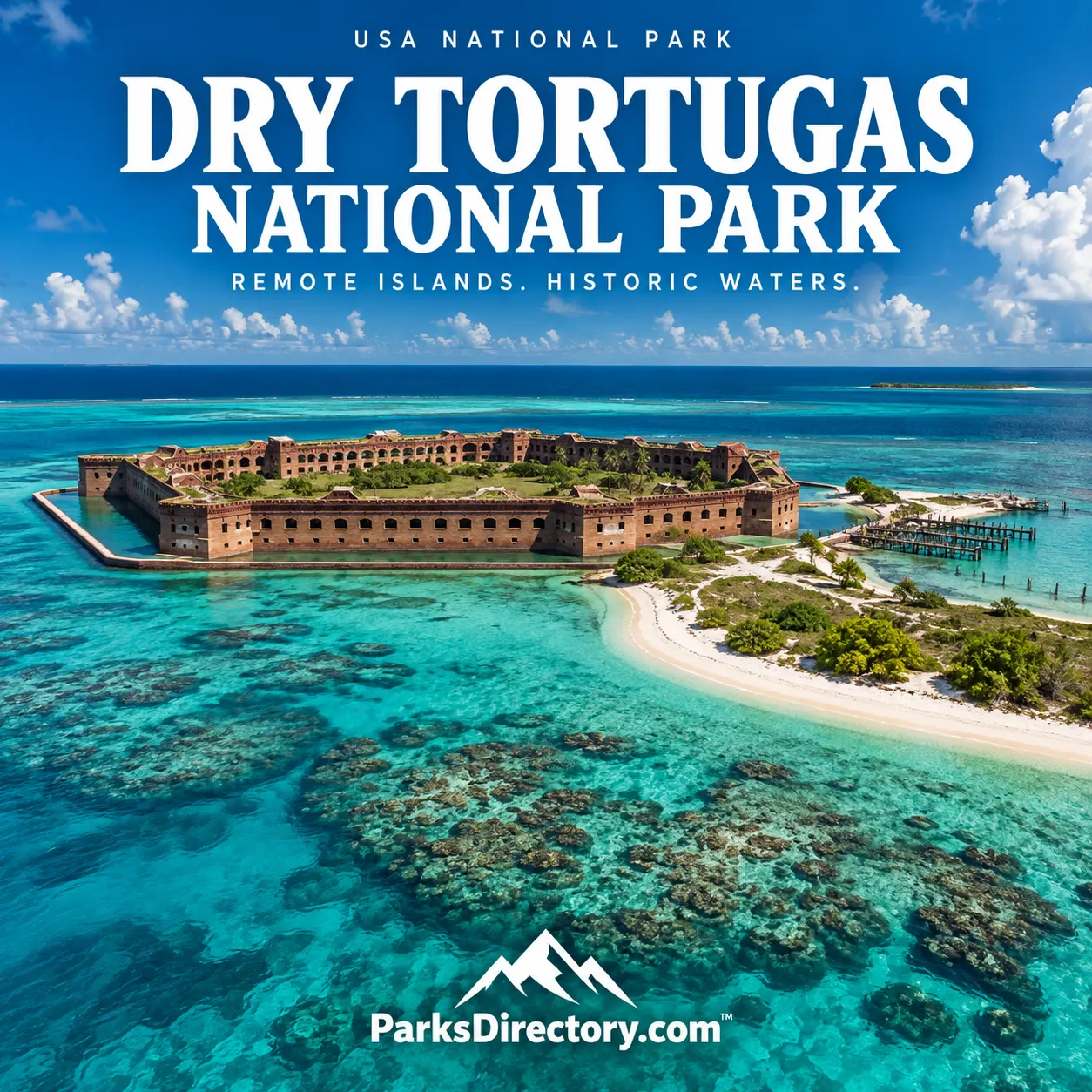
Fort Jefferson, on Garden Key, is the park’s most famous landmark. Construction began in the 1840s as part of a wider system of American coastal defense. Its massive masonry walls, repeated arches, gun positions, and enclosed spaces express the ambition to establish a powerful military presence in an isolated maritime setting. The fort was never fully completed, despite decades of work.[4:1]
Building and maintaining it required the movement of labor, food, materials, and water across open sea. Enslaved African Americans, military prisoners, and other workers contributed to its construction. Hurricanes, disease, supply difficulties, and changing military needs complicated the project. These experiences are essential to its history. The fort should not be understood only as an impressive geometric shape surrounded by turquoise water; it was also a demanding workplace and, for some people, a place of confinement.[4:2]
Civil War history and imprisonment
Fort Jefferson remained in Union hands during the Civil War and later became closely associated with imprisonment. Among its best-known prisoners was Dr. Samuel A. Mudd, who had treated the injured John Wilkes Booth after President Abraham Lincoln’s assassination. During an outbreak of yellow fever in 1867, Mudd helped care for the sick. His imprisonment and later release became one of the fort’s most widely told stories.[5]
The wider human history is larger than any single prisoner. Soldiers, laborers, families, medical personnel, and others lived within a remote community whose routines depended on supply and health conditions. The Army abandoned the fort in 1874, but the structure endured as an imposing reminder of nineteenth-century strategic thinking. Later monument protection transformed a former military place into a public historical resource.[5:1]
Why the national park extends underwater
Dry Tortugas is fundamentally a marine park. Coral reefs, reef fish, sea turtles, seabirds, and other marine life are part of its defining character. Protecting the islands without their surrounding waters would omit the environment that supports them. The National Park Service emphasizes natural resources both above and below the surface, making the park an important counterpoint to the common assumption that national parks consist mainly of terrestrial wilderness.[6]
The relationship between water and land is especially visible in the small scale of the keys. Their shores are exposed to weather, currents, and changing sea conditions, while their position makes them important to birds and marine animals. Human structures occupy only part of this setting. The park’s broader story includes biological communities that would remain significant even if Fort Jefferson had never been built.[1:1][6:1]
The sights and features that define the park
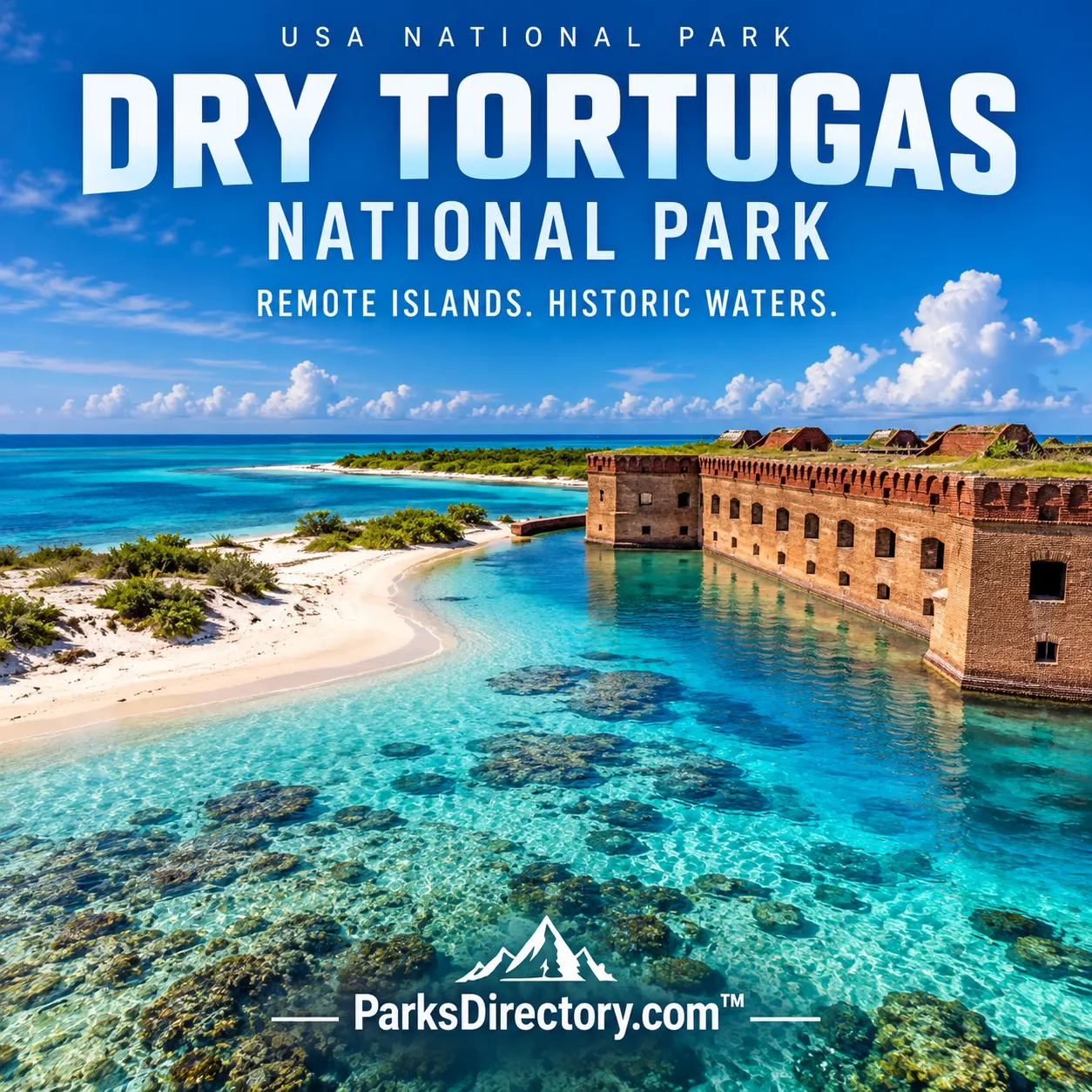
Garden Key and Fort Jefferson provide the most recognizable image: a large brick fort surrounded by shallow blue water. Walking through its spaces reveals the contrast between open courtyards and enclosed masonry chambers. The moat and surrounding shoreline add another layer to the relationship between engineering and the sea. The site’s appeal comes from that combination of historical mass and an unusually exposed natural setting.[4:3][7]
Loggerhead Key, other island settings, reefs, and submerged shipwrecks broaden the park beyond the fort. The National Park Service highlights both terrestrial and underwater places, reflecting the area’s dual identity as a cultural and natural preserve. A shipwreck can function as historical evidence while also becoming part of a marine habitat. Such overlaps are especially important here because much of the park’s significant material is not visible from an ordinary land-based viewpoint.[7:1]
Bird life is another defining feature. The islands and surrounding waters support a notable assemblage of birds, while sea turtles and reef communities reinforce the sense that this is an ecological crossroads. The experience can appear visually simple—water, sky, a small island—but its biological relationships are anything but simple. The limited amount of dry land makes the surrounding marine system more important, not less.[1:2][6:2]
A different model of an American national park
Dry Tortugas combines a small-island landscape with an unusually large historical structure and an extensive underwater setting. The 1935 monument recognized the fort’s significance; the 1992 park designation placed it within a more comprehensive conservation story. Those two dates help explain the difference between preserving a monument and protecting the wider environment in which that monument exists.
For a national-park reader, the most useful way to understand Dry Tortugas is to begin with the sea. Maritime routes explain the fort, supply challenges explain much of its human history, and marine ecosystems explain most of the park’s area. The result is a place where American military history and ocean conservation cannot be separated. Its famous brick walls are an introduction, not the full extent of what is protected.
Sources
Research checked September 6, 2026. The area is a conversion of the NPS’s approximate 100-square-mile description, not an exact acreage inventory; most of it is water.
National Park Service, Dry Tortugas National Park. ↩︎ ↩︎ ↩︎
National Park Service, History & Culture. ↩︎
National Oceanic and Atmospheric Administration, Dry Tortugas National Park. ↩︎ ↩︎
National Park Service, Florida: Dry Tortugas National Park. ↩︎ ↩︎ ↩︎ ↩︎
National Park Service, Dry Tortugas Was a Part of American History. ↩︎ ↩︎
National Park Service, Places to Go. ↩︎ ↩︎