Yellowstone National Park: Summary, History, and the Beginning of a Global Park Idea
ParksDirectory.com™ | National Park Summary & History
A landscape that helped define national parks
Yellowstone National Park combines extraordinary hydrothermal features with forests, lakes, waterfalls, mountains, and large wildlife. Its best-known sights include Old Faithful, Grand Prismatic Spring, the terraces of Mammoth Hot Springs, and the Grand Canyon of the Yellowstone. Yet its importance is not confined to individual attractions. Yellowstone protects the heart of a connected ecosystem and occupies a foundational place in the history of national parks.[1]
The park is both a destination and a continuing conservation experiment. Its history includes landmark protection, Indigenous dispossession, military administration, changing scientific understanding, and efforts to restore wildlife and natural processes.[2][3]
Location, size, and regional setting
Yellowstone lies primarily in northwestern Wyoming, with smaller portions in Montana and Idaho. The National Park Service’s park-facts page lists approximately 2,221,766 acres, or 3,472 square miles, while noting that its area figures remain subject to verification. About 96 percent of the park lies in Wyoming, with roughly 3 percent in Montana and 1 percent in Idaho.[4]
The scale encompasses far more than the roadside geyser basins. Mountainous terrain, broad plateaus, grasslands, forests, and extensive waters create a diverse protected landscape. The national park is also distinct from the larger Greater Yellowstone Ecosystem, whose ecological relationships and animal movements extend beyond the park boundary.[1:1][4:1]
Establishment on March 1, 1872
President Ulysses S. Grant signed the Yellowstone National Park Protection Act on March 1, 1872. The law established what is widely recognized as the world’s first national park, reserving the area from settlement and sale for public benefit. Yellowstone’s founding occurred decades before the National Park Service itself existed.[5]
Public attention had grown through expeditions in 1869, 1870, and 1871. The Hayden expedition was particularly influential: scientific observations, William Henry Jackson’s photographs, and artwork by Thomas Moran and others helped communicate the landscape to distant decision-makers.[5:1] Political advocacy and commercial expectations also mattered. Railroad interests recognized tourism’s potential, making the park’s creation a more complicated story than a purely spontaneous act of preservation.[2:1]
A homeland before federal protection
Native peoples knew and used Yellowstone long before nineteenth-century expeditions. Archaeological evidence and Tribal histories document hunting, fishing, plant gathering, obsidian quarrying, travel, and spiritual relationships extending back thousands of years. Yellowstone’s own anniversary interpretation emphasizes both historical and modern connections with associated Tribes.[6]
The creation of a national park did not erase these relationships, but it occurred within a wider period of displacement and confinement to reservations. Describing Yellowstone as an untouched place discovered by explorers obscures that history. A fuller account recognizes federal protection as a major conservation development while also acknowledging its relationship to the loss of Indigenous access and authority.[2:2]
Soldiers, rangers, and early tourism
Early administrators struggled to prevent poaching and damage with limited resources. The U.S. Army assumed management in 1886, establishing a long presence at Mammoth Hot Springs. The buildings of Fort Yellowstone remain tangible evidence of that period, when soldiers performed many duties later associated with park rangers.[7]
The National Park Service was created in 1916, and it took over Yellowstone’s management in 1918. Tourism also changed rapidly: rail connections, hotels, stagecoaches, and eventually automobiles reshaped how travelers reached and experienced the park. Those developments are part of Yellowstone’s history, not merely conveniences added around its natural features.[3:1]
Old Faithful and the architecture of park travel
Old Faithful remains Yellowstone’s most recognizable geyser. Its appeal lies in the spectacle of heated water and steam erupting into the open sky, set within the much larger Upper Geyser Basin. It is a natural system whose behavior is observed and predicted, not a mechanical fountain operating on an exact timetable.[8]
Nearby, the Old Faithful Inn, built in 1903–1904 to a design by Robert Reamer, represents another kind of landmark. Its large log structure and dramatic interior helped shape the rustic architectural tradition associated with American parks. Together, geyser and inn reveal the interaction between natural wonder and the buildings designed to accommodate people drawn to it.[8:1]
Heat, water, and the colors of the basins
Yellowstone’s hydrothermal features express a volcanic system beneath a landscape also shaped by glaciation and erosion. Geysers, hot springs, mudpots, and steam vents differ because of variations in water supply, heat, chemistry, and underground pathways. This variety is a major reason the area became scientifically important as well as visually famous.[9][10]
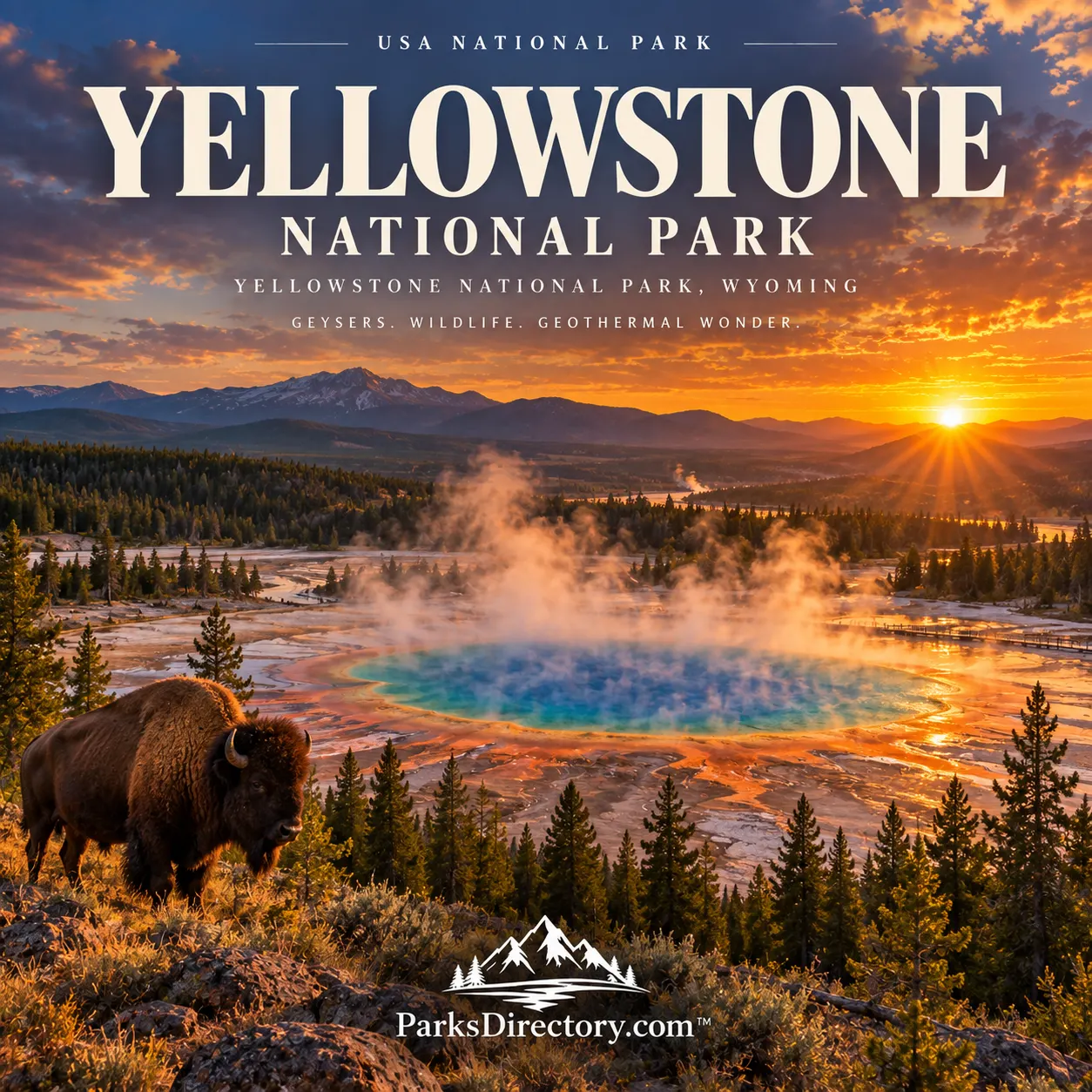
Many vivid colors around hot springs come from communities of heat-loving microorganisms. Blue water, colored microbial mats, mineral deposits, and rising steam create effects that vary across different features. Grand Prismatic Spring, in the Midway Geyser Basin, is among the most celebrated examples of this striking visual landscape.[10:1][11]
At Mammoth Hot Springs, dissolved calcium carbonate builds travertine terraces. These formations can change as water shifts between outlets, demonstrating that the park’s most familiar sights are products of continuing processes rather than permanent arrangements.[7:1]
Waterfalls, valleys, and wildlife
The Grand Canyon of the Yellowstone provides another signature view. The river has eroded weakened volcanic rock into a deeply colored canyon, with the 308-foot Lower Falls as its best-known waterfall. The canyon’s shape and mineral colors connect flowing water with the region’s volcanic and hydrothermal history.[12]
Nearby Hayden Valley and the more distant Lamar Valley are strongly associated with wildlife. Yellowstone’s bison are especially significant because a free-ranging population survived here despite the near destruction of the species elsewhere. Protection and management helped rebuild the herd, but migration beyond park boundaries continues to connect its future with surrounding communities and jurisdictions.[13]
Wolves, fire, and changing conservation ideas
The return of wolves in 1995 and 1996 marked a major reversal of earlier predator-control policies. Restoration reestablished a missing native predator and created opportunities to study ecological relationships. Those relationships are complex: prey populations and vegetation respond to weather, other predators, human management, and many interacting influences, not wolves alone.[14][15]
The 1988 fires similarly reshaped public understanding. Severe drought and extensive burning prompted concern about the park’s future, but subsequent research documented regeneration and a varied mosaic of burned and unburned habitat. The episode underscored the difference between preserving a fixed picture and conserving an ecosystem in which disturbance has a natural role.[16]
Yellowstone’s enduring significance
Yellowstone is most famous for spectacular sights, but its deeper legacy is the continuing effort to protect a living landscape. Its history is neither a simple triumph nor a finished project. It combines extraordinary preservation with difficult decisions about people, wildlife, access, and change.[2:3][15:1]
For a traveler, that perspective adds depth to every encounter—from an eruption at Old Faithful to bison crossing open grassland. The park established in 1872 remains a place where the meaning of conservation is actively explored.[5:2][13:1]
Sources
Research checked September 6, 2026. Area follows the approximate figure published on the NPS park-facts page; other datasets may report slightly different totals.
National Park Service, “Places To Go.” https://www.nps.gov/yell/planyourvisit/placestogo.htm ↩︎ ↩︎
National Park Service, “President Grant and the Yellowstone National Park Protection Act.” https://www.nps.gov/articles/000/president-grant-and-the-yellowstone-national-park-protection-act.htm ↩︎ ↩︎ ↩︎ ↩︎
National Park Service, “Timeline of Human History in Yellowstone.” https://www.nps.gov/yell/learn/historyculture/timeline.htm ↩︎ ↩︎
National Park Service, “Park Facts.” https://www.nps.gov/yell/planyourvisit/parkfacts.htm ↩︎ ↩︎
National Park Service, “Birth of a National Park.” https://www.nps.gov/yell/learn/historyculture/yellowstoneestablishment.htm ↩︎ ↩︎ ↩︎
National Park Service, “150 Years of Yellowstone.” https://www.nps.gov/yell/getinvolved/150-years-of-yellowstone.htm ↩︎
National Park Service, “Mammoth Hot Springs and the North.” https://www.nps.gov/yell/planyourvisit/explore-mammoth.htm ↩︎ ↩︎
National Park Service, “Old Faithful.” https://www.nps.gov/yell/planyourvisit/exploreoldfaithful.htm ↩︎ ↩︎
National Park Service, “Geology.” https://www.nps.gov/yell/learn/nature/geology.htm ↩︎
National Park Service, “Hydrothermal Features.” https://www.nps.gov/yell/learn/nature/hydrothermal-features.htm ↩︎ ↩︎
National Park Service, “Madison and the West.” https://www.nps.gov/yell/planyourvisit/madisonplan.htm ↩︎
National Park Service, “Canyon Village and the Grand Canyon.” https://www.nps.gov/yell/planyourvisit/canyonplan.htm ↩︎
National Park Service, “Bison Ecology.” https://www.nps.gov/yell/learn/nature/bison.htm ↩︎ ↩︎
National Park Service, “History of Wolf Management.” https://www.nps.gov/yell/learn/historyculture/wolf-management.htm ↩︎
National Park Service, “Wolf Ecology.” https://www.nps.gov/yell/learn/nature/wolf.htm ↩︎ ↩︎
National Park Service, “1988 Fires.” https://www.nps.gov/yell/learn/nature/1988-fires.htm ↩︎