Carlsbad Caverns National Park: An Ancient Reef and the Extraordinary World Beneath It
ParksDirectory.com™ | National Park Summary & History
Location, acreage, and creation
Carlsbad Caverns National Park lies in the Guadalupe Mountains of southeastern New Mexico, southwest of the city of Carlsbad. Its aboveground setting is Chihuahuan Desert: rocky ridges, dry canyons, shrubs, and broad views toward the surrounding basin. The NPS lists 46,766 acres, approximately 73.1 square miles, including more than 33,000 acres of designated wilderness. That acreage describes the protected surface landscape; it is not a measurement of cave-floor area.[1]
President Calvin Coolidge proclaimed Carlsbad Cave National Monument on October 25, 1923. Congress established Carlsbad Caverns National Park on May 14, 1930. The change recognized a remarkable underground system, but the park’s significance extends beyond its principal visitor cave to desert habitat, water resources, fossils, and cultural history. “Carlsbad Cavern” is the name of the famous individual cave; “Carlsbad Caverns” is the national park.[2]
From Permian reef to limestone mountains
The story begins roughly 260 to 270 million years ago, when a marine reef complex developed along an ancient sea. The organisms building this reef differed from the corals commonly associated with reefs today. Sponges, algae, and other marine life contributed material that became thick limestone and dolomite. The Guadalupe Mountains preserve remnants of that ancient system, including the Capitan Reef.[3]
Later burial, uplift, and erosion transformed the setting. The modern desert mountains and the caverns within them are therefore different stages in one long history. Fossils in the rocks retain evidence of the vanished sea, while younger deposits and underground remains record later environments. Standing outside the cave entrance, it is worth imagining not an empty desert awaiting discovery, but a landscape whose present form is only the latest expression of a much older geological inheritance.
How the great rooms formed
Carlsbad’s enormous chambers did not form only through the familiar process of mildly acidic rainwater descending from the surface. Research here helped establish the importance of sulfuric-acid dissolution. Hydrogen sulfide associated with deeper deposits rose through fractures and interacted with groundwater, producing acid that dissolved the surrounding carbonate rock. This process helped create the large cave spaces.[3:1]
The formations decorating those spaces have a different, later history. Water carrying dissolved minerals deposited calcite and other materials, building stalactites, stalagmites, columns, draperies, and related features. In simple terms, one set of processes opened the rooms, while another furnished them. The distinction makes the cavern easier to understand: the scale of a chamber and the delicate appearance of a formation are products of connected but not identical geological processes.
People, bats, and early exploration
Indigenous people lived in and traveled through the Guadalupe Mountains long before federal protection. Archaeological evidence includes sites and markings associated with the surface landscape. Later ranching, mineral extraction, and tourism brought new uses. Cave entrances and bat flights were not unknown features waiting for a single outsider to discover them.[2:1]
Jim White, a young cowboy who explored and publicized Carlsbad Cavern, became central to its modern tourism history. His accounts, guided visits, and efforts to draw attention to the cave helped build public interest. Guano mining also formed part of the early commercial story, linking the cave’s bats to agricultural fertilizer markets. As photographs and exploration reports circulated, the underground landscape gained the national recognition that eventually supported monument and national park designation.[2:2]
The Big Room and the Natural Entrance
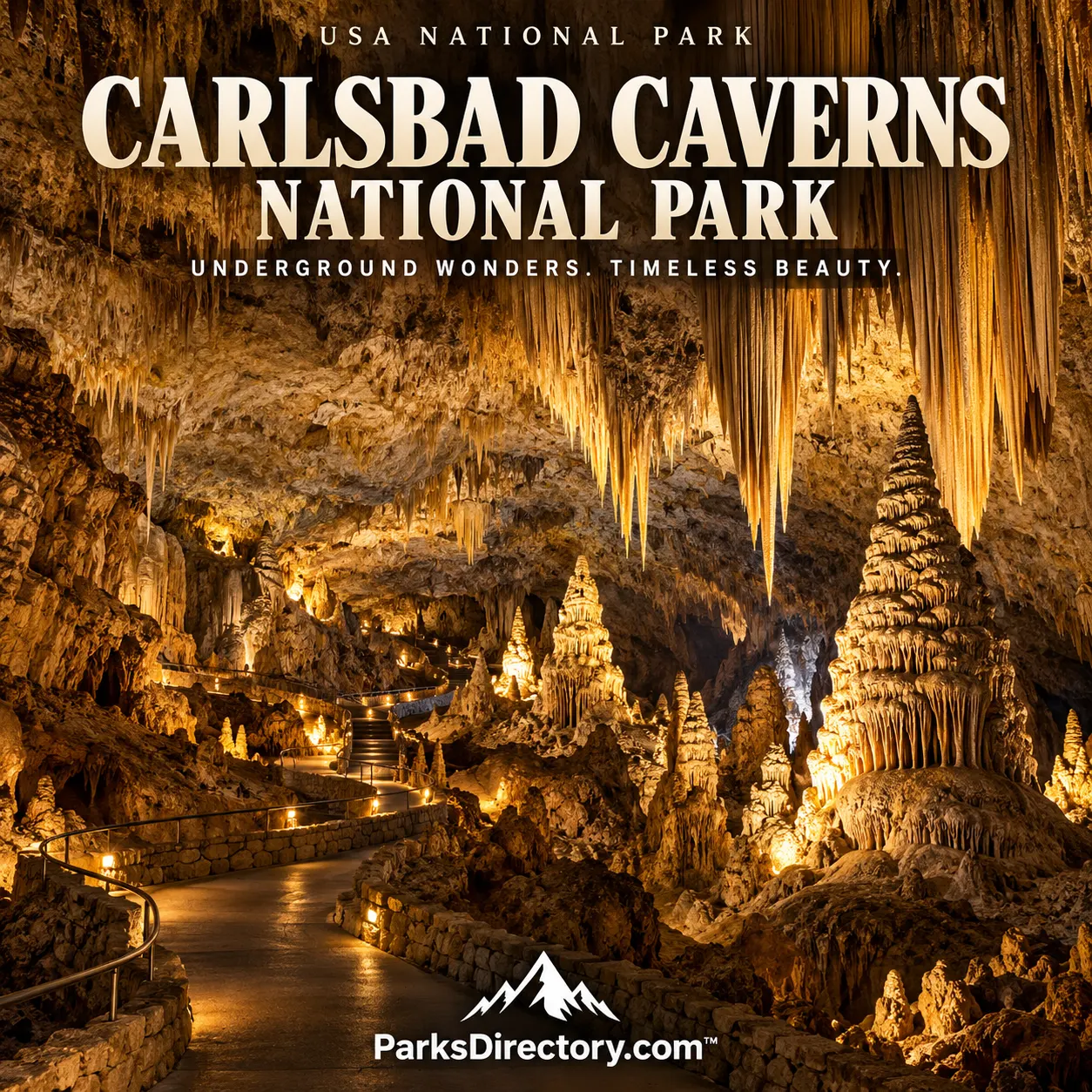
The park’s most celebrated interior is the Big Room, an immense chamber containing a remarkable concentration of formations. Its broad spaces challenge ordinary ideas about caves as narrow tunnels. A route around the room offers changing views of pillars, hanging formations, pits, and mineral surfaces. The experience is architectural in scale, although every feature belongs to a natural process rather than a designed building.[4]
The Natural Entrance provides another defining sight: a large opening descending from daylight into the cave. The transition gives visitors a strong sense of the relationship between surface and underground environments. Other named spaces, including King’s Palace, add to the cavern’s reputation for richly decorated rooms. Access arrangements and tours change, but these features explain the park’s enduring fame more reliably than any particular ticketing system or daily schedule.[4:1]
Lechuguilla and the limits of public access
Carlsbad Cavern is not the park’s only cave. Lechuguilla Cave, greatly expanded through exploration beginning in 1986, became internationally important for its depth, extensive passages, unusual mineral formations, and scientific value. The NPS describes extraordinary gypsum features among its notable discoveries. It is not a general sightseeing destination, and its restricted access is part of protecting a highly sensitive environment.[5]
Lechuguilla’s story changes the way one understands the national park. The most publicly accessible cave is not the full extent of what the park preserves, and exploration continues to enlarge scientific knowledge. The park’s protected area therefore includes resources whose importance cannot be judged from a visitor trail. Its 1995 World Heritage recognition reflected this exceptional geological setting and the outstanding character of its caves, rather than the appeal of a single underground attraction.[3:2][5:1]
The evening bat flight
The seasonal departure of Brazilian free-tailed bats from the cavern is one of the park’s best-known wildlife events. The bats emerge to feed on insects, connecting the underground roost with a much wider nighttime landscape. Numbers vary seasonally and from day to day, so a fixed population figure can give a misleading impression. The NPS also records other bat species using caves, trees, cliffs, and crevices throughout the park.[6]
Watching the outflight offers a useful counterpoint to the apparent stillness of mineral formations. The cavern is habitat as well as geology. Its temperature, passages, darkness, and openings support living systems. Protecting those systems requires attention to disturbance, disease, and conditions beyond the cave entrance. The famous flight is therefore more than a spectacle; it is a visible expression of an ecological relationship that continues after visitors leave.
A desert park with an underground identity
Aboveground wilderness, desert plants, canyons, and the Rattlesnake Springs area broaden the park beyond its cave-centered reputation. Water is especially significant in this dry country, both for surface life and for the underground processes that shaped the caverns. The protected landscape helps keep those connections intelligible.[1:1][7]
Carlsbad Caverns is ultimately known for a productive contrast: immense rooms beneath a seemingly austere desert, delicate formations within massive limestone, and lively bat colonies in a place associated with silence. Its establishment in 1930 secured an extraordinary public destination, but its deeper achievement was preserving a landscape in which ancient marine history, cave science, desert ecology, and human curiosity meet.
Sources
Research checked September 6, 2026. Acreage follows the scope and approximate figures of the cited sources; it is not a current boundary survey. Square-mile conversions are rounded.
National Park Service, Interesting Facts About Carlsbad Caverns. ↩︎ ↩︎
National Park Service, History & Culture. ↩︎ ↩︎ ↩︎
National Park Service, NPS Geodiversity Atlas—Carlsbad Caverns. ↩︎ ↩︎ ↩︎
National Park Service, Carlsbad Caverns National Park. ↩︎ ↩︎
National Park Service, Lechuguilla Cave. ↩︎ ↩︎