Wind Cave National Park: Summary, History, and the Prairie Above the Passageways
ParksDirectory.com™ | National Park Summary & History
Two landscapes in one national park
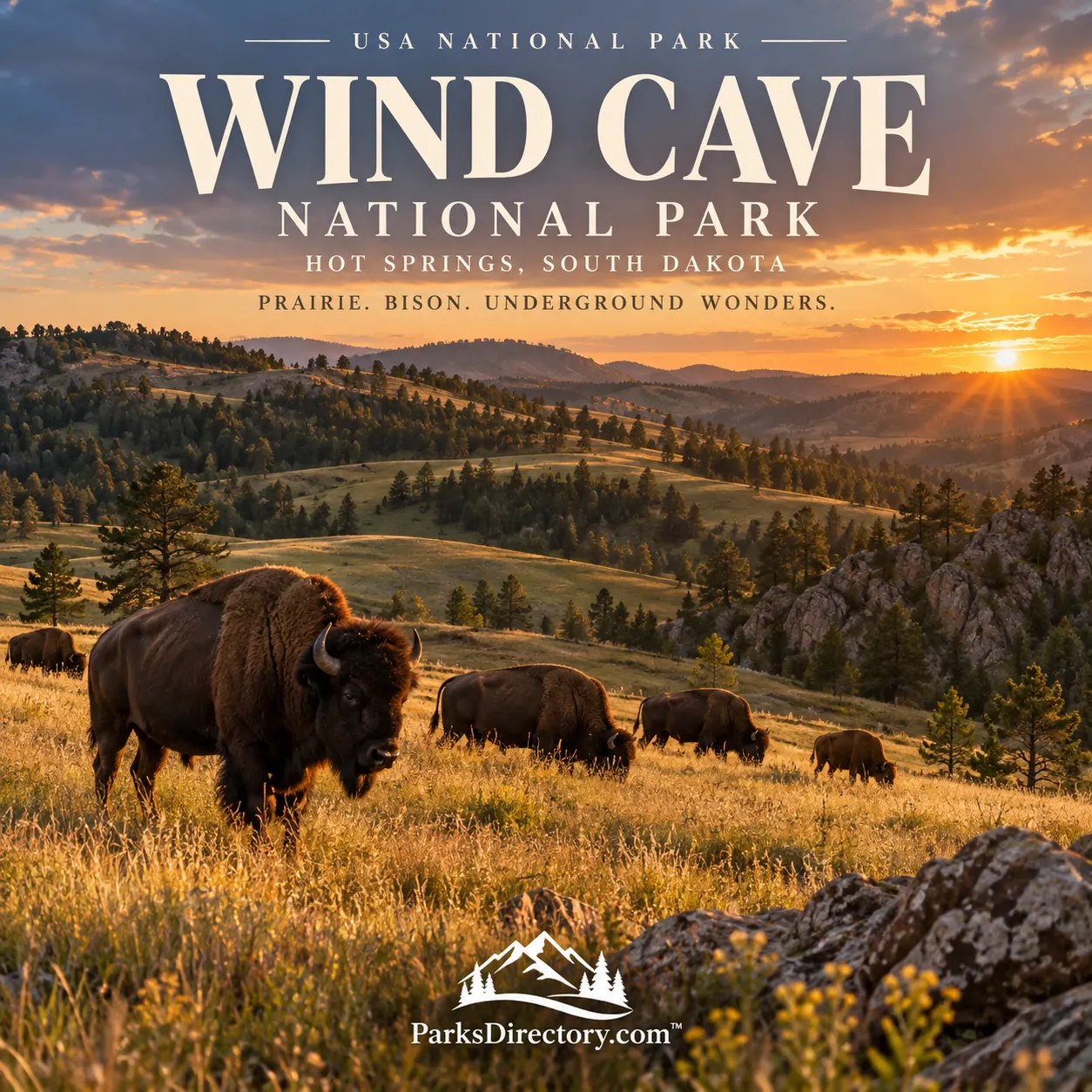
Wind Cave National Park brings together two strikingly different environments in South Dakota’s Black Hills. Above ground, grasslands open into rolling country where bison graze near ponderosa pine woodland. Below the surface lies a complicated cave system, celebrated for delicate mineral structures and passageways that continue to attract scientific investigation. The park’s identity depends on understanding both landscapes rather than treating the prairie as scenery on the way to a cave tour.[1]
This combination makes Wind Cave unusual within America’s national parks. It protects a subterranean geological resource while also preserving habitat and cultural relationships extending across the surface. Its history connects Indigenous traditions, nineteenth-century exploration, early federal conservation, and the restoration of native wildlife.[1:1]
Location and total area
The park lies north of Hot Springs in southwestern South Dakota, on the southern side of the Black Hills. The National Park Service’s geodiversity atlas reports approximately 33,924 acres, or about 53 square miles. That figure describes the park’s surface area, not the length or extent of its underground passageways.[2]
Wind Cave developed within limestone, including rocks known locally as the Pahasapa Limestone. Its underground spaces follow a complex arrangement within that bedrock rather than forming a single straightforward tunnel. The distinction between surface acreage and surveyed cave length matters: they measure entirely different aspects of the protected landscape.[2:1]
Establishment in 1903
President Theodore Roosevelt signed the legislation establishing Wind Cave National Park on January 9, 1903. The original park encompassed roughly 10,522 acres. Its creation was an early recognition that cave environments deserved national protection, not simply management as commercial attractions. Subsequent additions expanded the protected area and the range of resources entrusted to the National Park Service.[3]
A major modern enlargement occurred in 2011, when approximately 5,555 acres associated with the former Casey property were added. The park’s present scale therefore reflects more than a century of changing conservation priorities. Its founding date remains 1903, even though the boundaries and responsibilities familiar to visitors today developed over time.[3:1]
A sacred place before a national park
Wind Cave holds profound significance in Lakota traditions. The National Park Service presents an emergence account connecting the cave with the origins of people and bison. It also emphasizes that accounts differ among families and communities. These are living cultural traditions, not a single standardized story that outsiders can reduce to a decorative legend.[4]
Recognizing this significance changes how the park’s history is told. Euro-American documentation in the nineteenth century was not the beginning of human knowledge of the cave. A summary that starts only with explorers would miss the older and continuing relationships that make this place important beyond its mineral formations.[4:1]
Exploration and the expanding underground map
Tom and Jesse Bingham are associated with the cave’s first widely documented Euro-American encounter in 1881, including reports of air moving through its natural entrance. Exploration subsequently opened more of the underground landscape to public awareness. Early visitors entered a place whose size and complexity were far from understood.[5]
Modern exploration has become more systematic. Experienced cavers and researchers map passages, document formations, study biology and hydrology, and help repair disturbed areas. Work associated with the National Speleological Society contributed to this scientific approach during the twentieth century. The familiar visitor routes are therefore only a limited introduction to a much larger research landscape, and published passage totals can change as surveying continues.[5:1][6]
Boxwork: the park’s signature formation
Wind Cave is especially famous for boxwork, a network of thin calcite blades that projects from cave walls and ceilings. The intersecting partitions resemble an intricate honeycomb. Unlike familiar stalactites, boxwork is generally explained through the survival of mineral-filled fractures as surrounding rock dissolved away, rather than through drops depositing an ornament from the ceiling.[7]
That process gives the formations a distinctive appearance: the rock seems to display a delicate internal framework. Their scientific value is inseparable from their fragility. A passage may look solid at first glance, yet its most important features can be thin enough to suffer lasting damage from an accidental touch.[7:1]
Other underground features
The cave also contains formations known as frostwork and popcorn. Frostwork consists of fine mineral growths rather than frozen water; popcorn describes clustered, rounded deposits. Together with boxwork, these features demonstrate how different chemical and physical conditions create varied patterns within the same underground environment.[8]
Wind Cave is not defined primarily by the enormous hanging stalactites associated with some other show caves. Its distinction lies in the intricacy of its surfaces and the complexity of its passages. Understanding those differences helps visitors appreciate the cave on its own terms rather than measuring it against a generic picture of an underground chamber.[8:1]
New Deal work and public access
The Civilian Conservation Corps played an important role in the park’s twentieth-century development. A camp was organized in the mid-1930s, and crews worked on infrastructure both above and below ground. Projects included trails, stairs, lighting, an elevator shaft, buildings, roads, and water systems.[9]
These improvements connected conservation with public access during the Great Depression. They also left a lasting management challenge: welcoming visitors to a sensitive cave requires built systems, but maintaining those systems must not overwhelm the resource they serve. The park’s developed areas consequently form part of its history rather than existing outside the conservation story.[9:1]
Prairie restoration and historic homesteading
The surface landscape became increasingly important as protection broadened. Early twentieth-century wildlife efforts helped restore animals that had disappeared or declined locally. Today, bison, elk, pronghorn, and prairie dogs are central to the park’s ecological identity. Black-footed ferret restoration further illustrates the connections among species within prairie communities.[10]
The Sanson Homestead adds another dimension. Its history began in 1882 and continued through generations of ranching, reflecting family labor, adaptation, and the demands of life in the Black Hills. Preserved structures allow this settlement history to be considered alongside the park’s wildlife and Indigenous associations, without pretending that any one story accounts for the whole landscape.[11]
Why Wind Cave matters
Wind Cave is most known for its boxwork-filled passages, but its broader importance lies in the relationship between underground protection and the prairie above. Its history shows how a park established around an exceptional cave evolved into a more comprehensive conservation landscape.[1:2]
For a traveler, the most rewarding perspective is to hold both worlds together. The grassland is not an empty roof, and the cave is not simply an attraction beneath it. Each has its own history, inhabitants, and vulnerabilities; together they explain why this comparatively compact park has such an enduring place in America’s national-park system.[1:3]
Sources
Research checked September 6, 2026. Acreage is approximate and describes the park boundary, not the surveyed dimensions of the cave.
National Park Service, “Nature.” https://www.nps.gov/wica/learn/nature/index.htm ↩︎ ↩︎ ↩︎ ↩︎
National Park Service, “NPS Geodiversity Atlas—Wind Cave National Park.” https://www.nps.gov/articles/nps-geodiversity-atlas-wind-cave-national-park.htm ↩︎ ↩︎
National Park Service, “Wind Cave Time Line.” https://www.nps.gov/wica/learn/historyculture/wica-time-line.htm ↩︎ ↩︎
National Park Service, “The Lakota Emergence Story.” https://www.nps.gov/wica/learn/historyculture/the-lakota-emergence-story.htm ↩︎ ↩︎
National Park Service, “Cave Exploration.” https://www.nps.gov/wica/learn/historyculture/cave-exploration.htm ↩︎ ↩︎
National Park Service, “Frequently Asked Questions.” https://www.nps.gov/wica/faqs.htm ↩︎
National Park Service, “Boxwork.” https://www.nps.gov/wica/learn/nature/speleothems-boxwork.htm ↩︎ ↩︎
National Park Service, “Cave Formations.” https://www.nps.gov/wica/learn/nature/cave-formations-speleothems.htm ↩︎ ↩︎
National Park Service, “Civilian Conservation Corps at Wind Cave.” https://www.nps.gov/wica/learn/historyculture/civilian-conservation-corps-at-wind-cave.htm ↩︎ ↩︎
National Park Service, “Animals.” https://www.nps.gov/wica/learn/nature/animals.htm ↩︎
National Park Service, “Sanson Homestead.” https://www.nps.gov/wica/learn/historyculture/sanson-homestead.htm ↩︎