Theodore Roosevelt National Park: Summary, History, and the North Dakota Badlands
ParksDirectory.com™ | National Park Summary & History
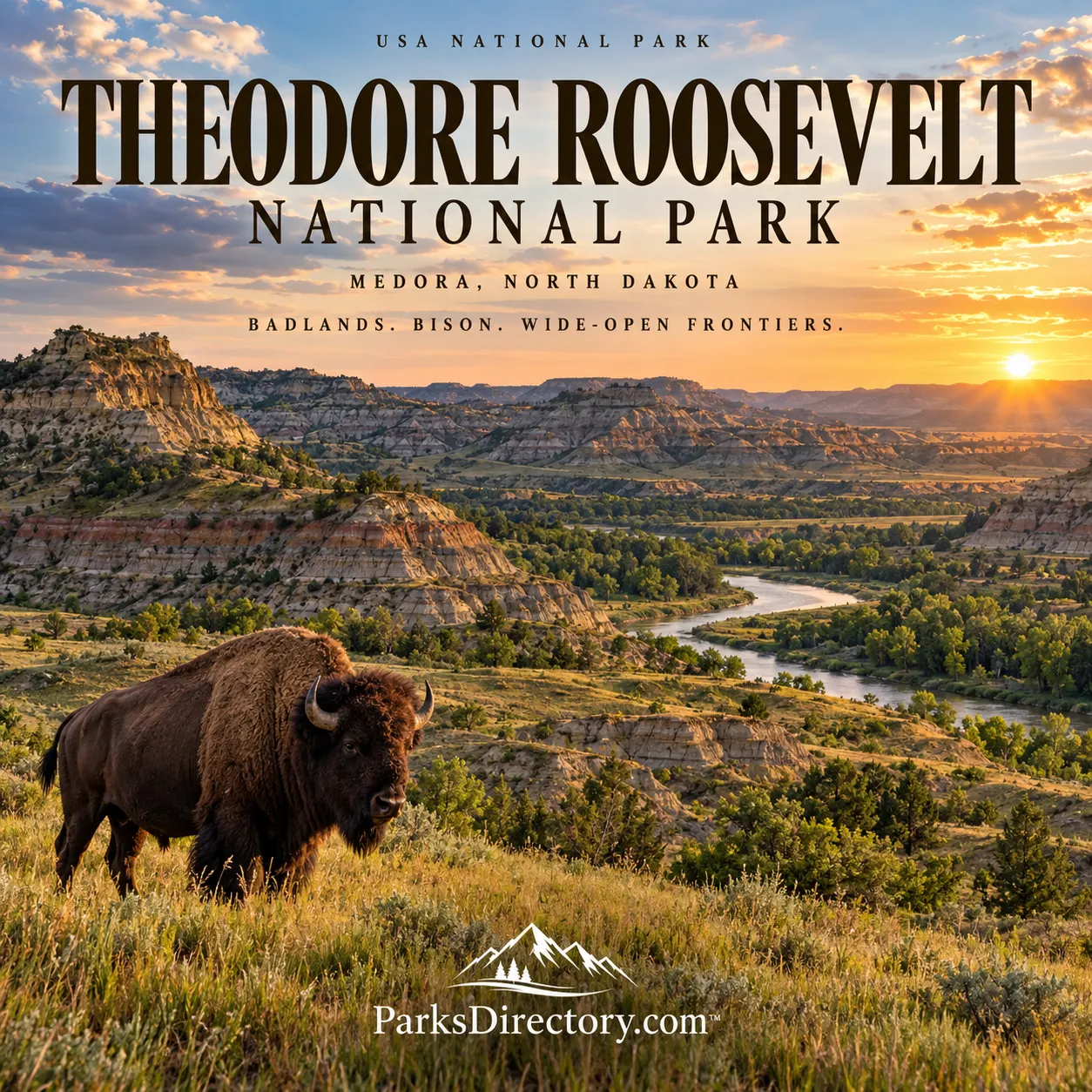
Theodore Roosevelt National Park opens a window onto a different kind of mountain country: not towering alpine peaks, but deeply eroded badlands interrupting the northern plains. Layered buttes, river bends, grasslands, and roaming bison give this western North Dakota landscape its character. The park is named for a president whose experiences here influenced his conservation outlook, yet its significance reaches beyond biography. Indigenous cultural connections, geological change, and wildlife restoration are equally important parts of the story.[1][2]
Location and total area
The park lies in western North Dakota, with Medora providing the best-known gateway to its South Unit. It contains three separate units: the South Unit, North Unit, and Elkhorn Ranch Unit. National Park Service statistics list a combined area of 70,446.89 acres, which is approximately 110 square miles. Rounded descriptions may give slightly different totals, but the three-unit arrangement is fundamental to understanding the park.[3]
The South Unit contains about 46,159 acres, the North Unit about 24,070 acres, and Elkhorn Ranch 218 acres. These are not three entrances into a continuous road network. Each protects a distinct portion of the Little Missouri badlands, and the ranch unit has a particularly focused historical purpose. Together they preserve both expansive scenery and the smaller setting associated with Roosevelt’s personal life.[3:1][4]
Establishment and the change in name
President Harry S. Truman signed the law creating Theodore Roosevelt National Memorial Park on April 25, 1947. The initial park included lands broadly corresponding to the South Unit and Elkhorn Ranch. The North Unit was added on June 12, 1948. These dates belong to the park’s federal establishment, decades after Roosevelt’s own time in Dakota Territory.[5]
On November 10, 1978, legislation signed by President Jimmy Carter changed the designation to Theodore Roosevelt National Park and established protected wilderness within it. The change recognized the landscape’s natural and cultural importance beyond its role as a presidential memorial. Thus, 1947 marks the park’s creation, while 1978 marks the national-park designation used today.[5:1]
Before Roosevelt: Indigenous cultural connections
The badlands were not an unknown or unused landscape when Roosevelt arrived. Archaeological evidence and tribal histories document hunting, gathering, travel, and spiritual relationships extending well before his lifetime. The Mandan and Hidatsa used the Little Missouri basin as bison-hunting country, while other peoples, including the Crow and Lakota, also have distinct histories associated with the wider region.[2:1]
Buttes, springs, and other places held meanings not captured by a scenic overlook label. The park remains culturally significant to Native peoples today. A responsible account should acknowledge these continuing connections without treating different nations as interchangeable or disclosing ceremonial knowledge simply as a tourist curiosity. The president’s experience is one chapter within a much older landscape.[2:2]
Roosevelt’s ranching years
Roosevelt first came to Dakota Territory in 1883, intending to hunt bison. During that visit he entered the cattle business, purchasing an interest in the ranch associated with the Maltese Cross brand. The experience exposed a wealthy young New Yorker to the practical demands of ranching and the rapid changes occurring across the plains.[6]
After the deaths of his wife and mother in 1884, he returned west and developed the Elkhorn Ranch as a more secluded home. The severe winter of 1886–1887 caused heavy cattle losses and demonstrated the limits of optimistic ranching assumptions. His western years were not an uninterrupted success story; weather, economics, and ecological realities all complicated the frontier image he helped popularize.[7]
Two very different historical sites
The Maltese Cross Cabin offers the more tangible architectural connection to Roosevelt’s early ranching experience. Its rooms and preserved structure make that period easier to imagine at a domestic scale. The cabin’s history also includes relocation and exhibition, reminding visitors that a historic building’s present setting may result from later preservation decisions rather than uninterrupted residence on its original site.[8]
At Elkhorn Ranch, the contrast is striking. The ranch house no longer stands; foundation stones and the riverside setting carry much of the meaning. This is a place where interpretation depends on landscape and historical evidence rather than a fully furnished building. Its relative simplicity helps distinguish Roosevelt’s actual retreat from the more elaborate mythology surrounding the American West.[4:1]
How the badlands were formed
The park’s bands of sedimentary rock record ancient environments very different from today’s grasslands. Rivers, floodplains, forests, and swamps left deposits that later became exposed and eroded. Sandstone, clay-rich beds, and other layers resist weathering differently, producing caprocks, buttes, gullies, and steep slopes. The scenery is therefore a visible record of both deposition and removal.[9]
The Little Missouri River continues to reshape its valley. Rain and runoff cut into soft materials, while burning coal seams can bake adjacent rock into reddish, more resistant material commonly called clinker. These processes help explain the park’s contrasting colors and profiles. The badlands are not a completed sculpture: they are a landscape continually being revised.[10]
The sights that define the park
The South Unit is known for its broad badlands views, wildlife, and the Painted Canyon landscape. Near Medora, it provides an immediate introduction to the contrast between open prairie and broken terrain. Looking across the country reveals why a place that appears relatively level from a distance becomes so complex when approached closely.[11]
The North Unit offers another sequence of river overlooks and eroded formations, including the River Bend Overlook and the Little Missouri valley. Its scenery complements rather than duplicates the South Unit. The park’s three-part geography encourages a layered understanding: presidential history at Elkhorn, expansive wildlife country in the South Unit, and striking river-and-badlands perspectives farther north.[12][4:2]
Bison and the work of conservation
Bison are among the park’s most recognizable animals, but their presence reflects conservation history rather than an unbroken remnant of enormous nineteenth-century herds. Bison were reintroduced to the park in 1956, following their near-elimination across much of the plains. The restored animals connect today’s visitor experience to a broader history of loss, survival, and deliberate recovery.[13]
Managing them requires attention to habitat and population size within a bounded park. The National Park Service also protects other species, including black-tailed prairie dogs, and works with a landscape shaped by grazing, fire, and weather. Theodore Roosevelt’s lasting significance is therefore not only commemorative. It is a working example of the continuing choices required to conserve wildlife and habitat, long after the legislation creating a park has been signed.[14][15]
Sources
Research checked September 6, 2026. Acreage follows the cited NPS three-unit statistics. Wildlife population totals and access conditions are deliberately not presented as fixed historical facts.
National Park Service, “Theodore Roosevelt National Park.” https://www.nps.gov/thro/ ↩︎
National Park Service, “Cultural History.” https://www.nps.gov/thro/learn/historyculture/cultural-history.htm ↩︎ ↩︎ ↩︎
National Park Service, “Park Statistics.” https://www.nps.gov/thro/learn/management/statistics.htm ↩︎ ↩︎
National Park Service, “Elkhorn Ranch Unit.” https://www.nps.gov/thro/planyourvisit/elkhorn-ranch-unit.htm ↩︎ ↩︎ ↩︎
National Park Service, “Park History.” https://www.nps.gov/thro/learn/historyculture/park-history.htm ↩︎ ↩︎
National Park Service, “Theodore Roosevelt the Rancher.” https://www.nps.gov/thro/learn/historyculture/theodore-roosevelt-the-rancher.htm ↩︎
National Park Service, “Elkhorn Ranch.” https://www.nps.gov/thro/learn/historyculture/elkhorn-ranch.htm ↩︎
National Park Service, “Maltese Cross Cabin.” https://www.nps.gov/thro/learn/historyculture/maltese-cross-cabin.htm ↩︎
National Park Service, “Geologic Formations.” https://www.nps.gov/thro/learn/nature/geologicformations.htm ↩︎
National Park Service, “Geologic Activity.” https://www.nps.gov/thro/learn/nature/geologicactivity.htm ↩︎
National Park Service, “South Unit.” https://www.nps.gov/thro/planyourvisit/south-unit.htm ↩︎
National Park Service, “North Unit.” https://www.nps.gov/thro/planyourvisit/north-unit.htm ↩︎
National Park Service, “Where Our Bison Came From.” https://www.nps.gov/thro/blogs/where-our-bison-came-from.htm ↩︎
National Park Service, “Bison Management.” https://www.nps.gov/thro/learn/nature/bison-management.htm ↩︎
National Park Service, “Animals” and “Climate Change.” https://www.nps.gov/thro/learn/nature/animals.htm ; https://www.nps.gov/thro/learn/nature/climate-change.htm ↩︎