Isle Royale National Park: Island Wilderness and the Living History of Lake Superior
ParksDirectory.com™ | National Park Summary & History
An archipelago in the northern Great Lakes
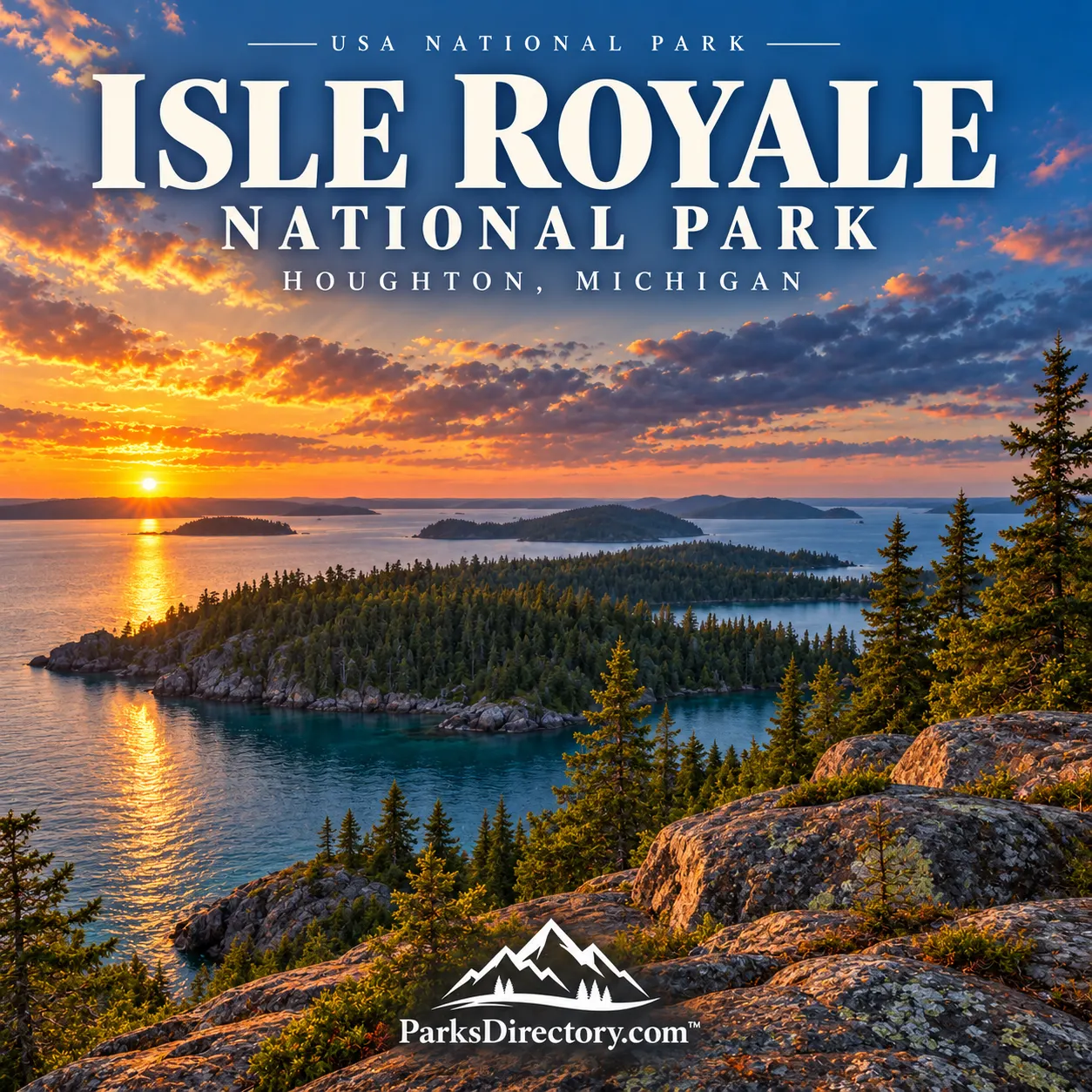
Isle Royale National Park is a landscape of forested ridges, rocky shores, sheltered harbors, and inland lakes surrounded by the enormous waters of Lake Superior. Its island setting gives it a distinctive rhythm: the crossing is part of the experience, and the lake remains a constant presence even when a trail leads deep into the woods. This is a Great Lakes park in which water is not scenery around the edges but a defining part of the protected area.[1]
The archipelago lies in northwestern Lake Superior, within Michigan’s Keweenaw County and near the Canadian border. Houghton, Michigan, is the mainland headquarters community rather than the physical location of the islands. The park covers approximately 571,790 acres, or 893 square miles, including extensive surrounding waters. Its main island and hundreds of smaller islands occupy only part of that total.[1:1][2]
Congress authorized the park on March 3, 1931, and it was officially established on April 3, 1940. These dates describe different steps in creating the park. Later wilderness designation, in 1976, strengthened protection for most of its land area without implying that the islands had never been inhabited or used.[1:2][3]
Minong and continuing Indigenous connections
For the Anishinaabe, Isle Royale is Minong, a place with enduring cultural and spiritual significance. The Grand Portage Band of Lake Superior Chippewa maintains connections to the islands and surrounding waters through fishing, gathering, and other traditions. Understanding the park as an ancestral landscape is essential: its distance from modern cities does not make it a place without human history.[4]
The island’s copper resources also connect it to a much older regional history. Indigenous people worked copper long before nineteenth-century commercial companies arrived. Archaeological sites and traditional knowledge provide different but complementary ways of understanding the relationship between people and this landscape. Visitors should regard cultural features as evidence to be protected, not as curiosities available for collection.[4:1][5]
Copper, fishing, and island communities
Commercial copper mining developed in several nineteenth-century phases. Ventures established mines, settlements, and transportation facilities, then often faded when extraction proved less profitable than hoped. Remains of these enterprises interrupt any simple impression of an island untouched by industry. They also demonstrate the practical difficulties of operating in a remote place where supplies, workers, and ore had to move across Lake Superior.[5:1]
Fishing proved a more durable livelihood. Families occupied shoreline camps, built fish houses and docks, and organized their lives around the lake’s resources and weather. Scandinavian immigrant fishing traditions became particularly important in this history. Preserved fisheries help explain the island as a working landscape, where small buildings and sheltered coves could be central to a family’s economic survival.[6]
Tourism later offered another use for former mining properties and island settlements. Resorts and cottages developed around the attraction of cool summers, fishing, and scenic isolation. This recreational history complicates the image of a park created from wholly unoccupied land. Some of the places now valued for their quiet once supported more concentrated visitor activity than their present appearance suggests.[7]
The making of a wilderness park
Federal authorization in 1931 did not immediately complete the process of establishing a park. Acquiring and administering an island landscape with existing owners and uses took time. Official establishment followed in 1940, placing the archipelago within a management framework that increasingly emphasized natural conditions and low-intensity recreation rather than a large resort destination.[1:3]
The 1976 wilderness designation formalized protection for most of the terrestrial landscape. Wilderness status and cultural history are not opposites here: a protected forest can contain traces of a mine, a fishing camp, or a former cottage community. The challenge is to preserve both ecological processes and significant evidence of human relationships with the islands, without treating either history as an inconvenience to the other.[3:1][6:1][7:1]
Ancient rocks and a glacial landscape
Isle Royale’s bedrock belongs to the ancient geological story of the Lake Superior region. Volcanic rocks associated with continental rifting helped establish the island’s underlying structure. Much later, glaciers reshaped that foundation, scouring the land and leaving a pattern of ridges, basins, shorelines, and inland waters. The long, narrow terrain reflects this interaction of older rock and more recent ice.[2:1]
The Greenstone Ridge forms a prominent backbone through the main island. From higher ground, the repeated pattern of forest and water becomes easier to understand. Along the shore, exposed rock, sheltered inlets, and small islands show how geological structure continues to influence travel and habitat. The park rewards a traveler who notices the shape of the land rather than looking only for one monumental landmark.[2:2][3:2]
Wolves, moose, and ecological research
Isle Royale is internationally known for its long-running study of wolves and moose. Research beginning in 1958 has examined predation, food availability, disease, weather, and the consequences of isolation. The island setting offers an unusually focused place to investigate relationships that are much harder to separate in larger, more connected landscapes.[8]
The research does not reveal a permanently balanced system. Populations change, genetic diversity matters, and climatic conditions affect both animals and the lake crossings that can connect them with the mainland. The value of the study lies in observing those changes over decades. For visitors, a moose sighting or a wolf track is therefore part of a larger scientific story, not merely an addition to a wildlife checklist.[8:1]
The park’s most memorable places
Rock Harbor and the western Windigo area introduce different ends of the main island. Forest paths, rocky points, inland lakes, and sheltered channels provide the characteristic scenery. The Greenstone Ridge offers a cross-island perspective, while shoreline routes keep Lake Superior’s changing moods close at hand. Travel by foot or small craft reveals the park gradually rather than through a succession of roadside overlooks.[3:3][9]
Historic fishing sites, lighthouses, and submerged shipwrecks add a maritime dimension to the landscape. Together with the forest and wildlife, they make Isle Royale a place where natural isolation and human connection remain intertwined. Its defining experience is not simply getting far away, but discovering how much history and ecological complexity can be contained within an island world.[6:2][9:1]
Sources
Research reviewed September 6, 2026. Total acreage includes surrounding Lake Superior waters and is not the main island’s land area. Authorization in 1931 is distinguished from official establishment in 1940. Wildlife populations are not presented as fixed current counts.
National Park Service, “Denice Swanke Selected as Superintendent for Isle Royale National Park,” establishment dates and acreage. https://www.nps.gov/isro/learn/news/denice-swanke-selected-isro-superintendent.htm ↩︎ ↩︎ ↩︎ ↩︎
National Park Service, “NPS Geodiversity Atlas—Isle Royale National Park, Michigan.” https://www.nps.gov/articles/nps-geodiversity-atlas-isle-royale-national-park-michigan.htm ↩︎ ↩︎ ↩︎
National Park Service, “Nature & Science.” https://www.nps.gov/isro/learn/nature/index.htm ↩︎ ↩︎ ↩︎ ↩︎
National Park Service, “Anishinaabe Heritage.” https://www.nps.gov/isro/learn/historyculture/american-indian.htm ↩︎ ↩︎
National Park Service, “Mines.” https://www.nps.gov/isro/learn/historyculture/mines.htm ↩︎ ↩︎
National Park Service, “Fisheries.” https://www.nps.gov/isro/learn/historyculture/fisheries.htm ↩︎ ↩︎ ↩︎
National Park Service, “Resorts & Cottages History.” https://www.nps.gov/isro/learn/historyculture/resorts-cottages.htm ↩︎ ↩︎
National Park Service, “Predator-Prey Relationships on Isle Royale.” https://www.nps.gov/articles/000/predator-prey-relationships-on-isle-royale.htm ↩︎ ↩︎
National Park Service, park overview and first-time visitor orientation. https://www.nps.gov/isro/ ; https://www.nps.gov/isro/planyourvisit/first-timer-s-guide.htm ↩︎ ↩︎