Hot Springs National Park: Thermal Waters and the Making of an American Spa
ParksDirectory.com™ | National Park Summary & History
A national park within a city
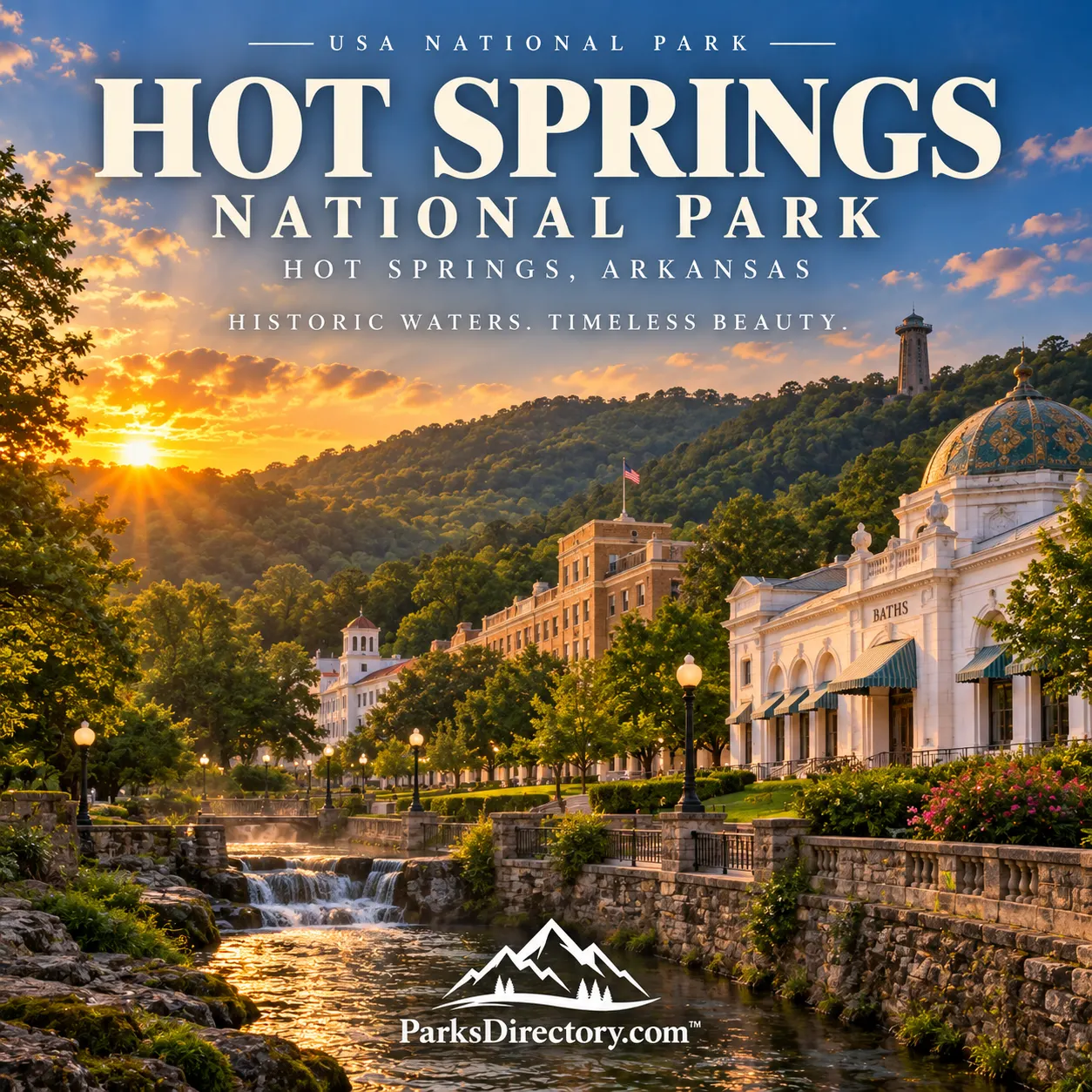
At Hot Springs National Park, the celebrated natural feature is not a distant mountain or an enormous canyon. It is water, emerging warm from the ground beside a historic Arkansas city. Elegant bathhouses stand below wooded slopes, connecting an urban streetscape to a protected underground system. This relationship between water, architecture, and public health gives Hot Springs a character unlike most American national parks.[1]
The park lies in Hot Springs, Arkansas, among the Zig Zag Mountains of the Ouachita region. National Park Service statistics report approximately 5,550 acres, equivalent to about 8.7 square miles. Its small footprint includes forested hills as well as the downtown historic district. Congress protected the springs as Hot Springs Reservation on April 20, 1832; the designation became Hot Springs National Park on March 4, 1921. The earlier reservation is an important conservation milestone, but it should not be confused with establishment under the later national-park title.[1:1][2]
Before the bathhouses
Human history here extends far beyond the development of a fashionable bathing resort. Indigenous people used the region and quarried novaculite, a hard stone well suited to making tools. Archaeological evidence provides a more reliable introduction to this early history than the romantic stories sometimes repeated about universal peace or miraculous cures at the springs. The landscape was already known, used, and culturally meaningful before American officials began describing its resources.[3]
After the Louisiana Purchase, the federal government sought information about the newly acquired territory. The Dunbar-Hunter expedition examined the hot springs in 1804, documenting a remarkable natural phenomenon that would attract increasing national attention. Over the following decades, settlement and commercial bathing developed around the springs. Protecting the water did not immediately resolve questions of ownership, access, or construction: the 1832 reservation initially lacked the administrative machinery needed to manage the growing community effectively.[1:2]
Water warmed underground, not by a volcano
The springs are not evidence of an active volcano beneath Arkansas. Rainwater enters the surrounding ground and travels downward through fractures and permeable rock. At depth, the normal increase in underground temperature warms the water before it rises through faults and fissures. National Park Service research describes a journey lasting thousands of years; the thermal water averages roughly 143 degrees Fahrenheit when it emerges.[4]
This explanation makes the wooded recharge landscape as important as the visible outlets. Protecting a spring requires attention to the land through which its water moves, not merely a fence around its final opening. The park’s hills are therefore more than a pleasant background to Bathhouse Row. They belong to the natural system that makes the bathhouses possible. For visitors, seeing warm water at the surface becomes more meaningful when understood as the last stage of a long, mostly invisible journey.[4:1]
The rise of Bathhouse Row
By the late nineteenth century, Hot Springs had become a prominent destination for bathing treatments and health tourism. A devastating fire in 1878 helped spur reconstruction. Enclosure of Hot Springs Creek beneath an underground arch in 1882–1883 changed the townscape, addressing sanitation and flooding problems while creating space for the streetscape visitors recognize today. The historic creek should not be imagined as an open stream flowing past the present bathhouse entrances.[1:3]
The eight surviving buildings of Bathhouse Row were constructed between 1892 and 1923. Their varied facades, porches, decorative interiors, and landscaped setting reflect successive ideas about comfort, medicine, and leisure. The district received National Historic Landmark recognition in 1987. Together the buildings demonstrate how a natural resource could generate an entire architectural culture, complete with specialized rooms, equipment, workers, and rituals of treatment.[5]
The Fordyce Bathhouse is the most revealing introduction to this world. Its preserved spaces make the scale and organization of historic bathing tangible: treatment was an elaborate process, not simply a dip in a pool. As a museum and visitor orientation site, the building allows travelers to understand an industry whose routines would otherwise be difficult to reconstruct from exterior photographs alone.[6]
A complicated history of access
The spa’s attractive buildings should not obscure the unequal society in which they operated. African American workers supplied essential labor, while racial segregation shaped access to bathing facilities. The government free bathhouse served people unable to afford commercial treatments, but later versions separated users by race and sex. Black-owned and Black-serving establishments also became important parts of the city’s bathing economy.[7]
These histories broaden the meaning of preservation. Bathhouse Row is not only a collection of handsome buildings or a nostalgic celebration of luxury travel. It is a place to examine the relationship between public resources and private businesses, the experiences of workers, and the barriers encountered by visitors seeking care. Historical claims about medical benefits belong to their period; they are not modern guarantees that thermal bathing will cure disease.[7:1]
The places that define the park
Several bathhouses provide memorable visual anchors. The Hale is the oldest surviving building on the row. The Quapaw’s tiled dome makes it especially recognizable, while the Buckstaff represents the continuity of traditional bathing operations from the early twentieth century. Other buildings have taken on new uses, illustrating an approach to preservation that keeps the district active rather than turning every structure into an identical museum.[5:1]
Above the row, the Grand Promenade offers a different perspective on the architecture and springs. Farther into the hills, forest trails and mountain overlooks reveal the park’s quieter side. The change from a busy sidewalk to a wooded path is one of Hot Springs’ most distinctive experiences: urban and natural landscapes remain closely connected rather than separated into different destinations.[8]
Why Hot Springs matters
Hot Springs preserves an unusually complete relationship between geology and society. Underground circulation created the thermal resource; Indigenous land use preceded federal protection; nineteenth-century tourism reshaped a settlement; and twentieth-century bathhouses gave that resource a monumental public face. Reading those layers together prevents the park from being reduced either to a spa district or to a set of warm-water outlets.[1:4][4:2][5:2]
For a national-parks traveler, its significance lies precisely in that combination. The wooded slopes explain the water, the buildings explain the bathing industry, and the social history explains who benefited from it. Few parks make the connections between a natural process and everyday human institutions so immediately visible.[6:1][7:2][8:1]
Sources
Research reviewed September 6, 2026. Acreage follows the cited NPS statistics overview, not a new boundary survey. Square miles are rounded conversions. Historical bathing practices are described as history, not medical advice.
National Park Service, “History & Culture.” https://www.nps.gov/hosp/learn/historyculture/index.htm ↩︎ ↩︎ ↩︎ ↩︎ ↩︎
National Park Service, “Park Statistics,” acreage summary updated May 5, 2020. https://www.nps.gov/hosp/learn/management/statistics.htm ↩︎
National Park Service, “Archeology.” https://www.nps.gov/hosp/learn/historyculture/archeology.htm ↩︎
National Park Service, “Hot Springs.” https://www.nps.gov/hosp/learn/nature/hotsprings.htm ↩︎ ↩︎ ↩︎
National Park Service, “Bathhouse Row Today.” https://www.nps.gov/hosp/learn/historyculture/bathhouse-row-today.htm ↩︎ ↩︎ ↩︎
National Park Service, “Fordyce Bathhouse.” https://www.nps.gov/hosp/learn/historyculture/fordyce-bathhouse.htm ↩︎ ↩︎
National Park Service, “African Americans and the Hot Springs Baths.” https://www.nps.gov/articles/000/african-americans-and-the-hot-springs-baths.htm ↩︎ ↩︎ ↩︎
National Park Service, “Nature & Science.” https://www.nps.gov/hosp/learn/nature/index.htm ↩︎ ↩︎