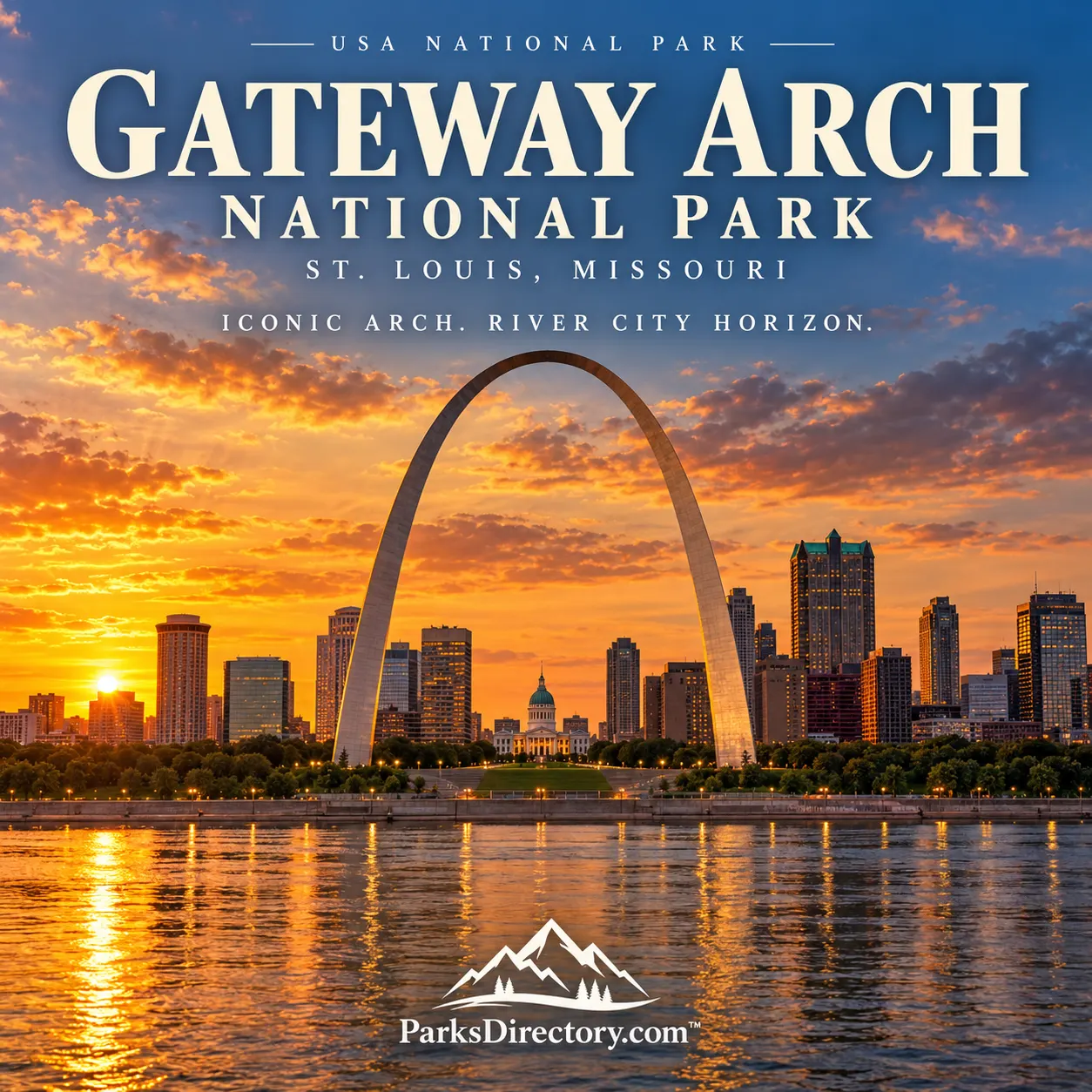
Gateway Arch National Park: Architecture, Expansion, and the History of St. Louis
ParksDirectory.com™ | National Park Summary & History
Location, size, and establishment
Gateway Arch National Park occupies the Mississippi riverfront in downtown St. Louis, Missouri. Unlike most national parks, its defining landscape is urban and deliberately designed. The National Park Service’s history page reports 90.96 acres, approximately 0.142 square mile; its nature page rounds that to 91 acres. This article follows those park-specific NPS descriptions rather than treating a differently reported gross-boundary figure as interchangeable with the developed historic park.[1][2]
The site entered the National Park System in 1935 as Jefferson National Expansion Memorial. Its present designation, Gateway Arch National Park, dates to February 22, 2018. These dates describe different events: the earlier creation of the protected memorial and the later congressional change of name and classification. The 2018 legislation did not suddenly create the arch, which had already stood for more than half a century.[3][4]
The park brings together the Gateway Arch, its underground museum, landscaped grounds, and the Old Courthouse. The combination makes it a place to consider architecture and engineering alongside the complicated history of American expansion.[1:1]
A river city connected to the continent
St. Louis developed at a strategic point in the Mississippi River system. Its history connects Indigenous communities, French and Creole settlement, trade, transportation, and the growing United States. The park’s museum uses these overlapping stories to explain why this city became closely associated with movement into the continental interior.[5]
That history is more complicated than the familiar phrase “Gateway to the West.” For traders, settlers, and political leaders, westward movement could mean opportunity, markets, or territorial ambition. For Indigenous nations, the same processes could bring dispossession, conflict, and profound changes to sovereignty and daily life. Enslaved people and free African Americans experienced still other constraints and possibilities. The park’s interpretive purpose includes these different experiences rather than presenting expansion as a single, uncomplicated achievement.[6]
The Mississippi remains an essential part of the setting. From the grounds, the river places the monument within a working transportation landscape instead of isolating it as a sculpture without context. The relationship between waterfront, city, and interior trade helps explain both the original memorial idea and the museum’s broad historical scope.[5:1]
From memorial proposal to national park
President Franklin D. Roosevelt’s 1935 executive order directed the acquisition and development of a 40-block riverfront area for Jefferson National Expansion Memorial. The project joined national commemoration with an ambitious transformation of the city waterfront. In 1940, St. Louis transferred the Old Courthouse to the National Park Service, adding a major historic building to the developing memorial.[6:1]
A nationwide architectural competition in 1947–1948 produced Eero Saarinen’s winning design. Rather than proposing a conventional statue or column, Saarinen envisioned a vast stainless-steel arch. Its simplicity was central to its effect: an unmistakable silhouette, visible across the city and river, that could function as both landmark and symbolic gateway.[1:2]
The project unfolded over many years. Construction of the arch itself began in 1963, and the final section was installed on October 28, 1965. Landscaping, the visitor facilities, and later improvements continued to shape the public experience. A major twenty-first-century redevelopment strengthened connections between the grounds and downtown, while the 2018 redesignation gave the established memorial its present national-park name.[1:3][6:2]
The arch and its engineering
The Gateway Arch is 630 feet high and 630 feet wide at ground level. Its stainless-steel exterior changes appearance with light and weather, while the huge open space beneath it preserves a visual relationship with the river and sky. From close range, the legs seem almost separate; from farther away, the continuous curve becomes the dominant impression.[5:2]
Although its outline appears effortless, the structure depended on sophisticated engineering and construction methods. Deep foundations anchor the two legs, and the monument was designed to accommodate wind and other structural forces. Its unusual internal tram system transports visitors through the curved structure to the observation area, turning the building itself into part of the interpretive experience.[1:4]
The construction story is also a story of people. Architects, engineers, steelworkers, and other trades transformed an abstract design into an enormous physical object. The museum’s treatment of the project helps explain that the monument was not simply placed on the riverfront; it emerged from public decisions, labor, technical experimentation, and competing ideas about what a national memorial should mean.[7]
The Old Courthouse and the struggle for freedom
The Old Courthouse provides an essential counterpoint to the arch. Its nineteenth-century rooms and dome connect the park to the legal and civic life of St. Louis. The first two trials associated with the Dred Scott freedom case were held here in 1847 and 1850. Dred and Harriet Scott’s efforts to secure freedom became part of a legal struggle with consequences far beyond Missouri.[1:5][8]
It is important to distinguish the local courthouse proceedings from the U.S. Supreme Court’s infamous 1857 decision. The national case did not take place inside this building, but the Scotts’ earlier litigation gives the courthouse direct historical significance. The park therefore asks visitors to consider liberty and citizenship alongside the territorial expansion commemorated nearby.[8:1]
The building’s presence changes the meaning of the overall site. Without it, a visit might focus almost entirely on the arch’s height and design. With it, the national park also contains a setting where individuals challenged the legal structures that constrained their lives. Architecture becomes a route into questions of rights, power, and belonging.
The park’s most notable features and lasting meaning
The park is best known for the arch and the view from its summit, but its significance extends below and around the monument. The museum’s galleries interpret colonial St. Louis, Jefferson’s ambitions, river commerce, expansion, the changing West, and construction of the arch. The landscaped grounds provide space to appreciate the monument’s scale, while the waterfront retains the geographical connection that makes the memorial’s location meaningful.[5:3]
Gateway Arch is consequently a different kind of national park: not a refuge from the city, but an opportunity to examine the city as part of national history. Its small footprint contains several layers of time, from river trade and freedom suits to modern architecture and contemporary interpretation.
The essential experience is not simply looking upward. It is placing that famous curve beside the courthouse, the river, and the stories told underneath it. Together, these features make the park a setting for both admiration and reflection, where a celebrated national symbol can be considered in the full complexity of the history it represents.[6:3]
Sources
Research checked September 6, 2026. Area follows the 90.96-acre figure expressly reported on the NPS park history page, rounded to 91 acres on its nature page. This is not a claim that all historical or administrative boundary datasets use the same acreage.
National Park Service, Basic Information. ↩︎
National Park Service, Recent Changes to the National Park System. ↩︎
National Park Service, Park Brochure. ↩︎ ↩︎ ↩︎ ↩︎
National Park Service, Gateway Arch National Park Purpose and Significance. ↩︎ ↩︎ ↩︎ ↩︎
National Park Service, Building the Dream. ↩︎
National Park Service, Old Courthouse FAQ. ↩︎ ↩︎